
The nude woman in art: history, symbols, and evolution of the female nude
From Antiquity to contemporary art, the representation of the nude woman has held a major place in art history. Sculpture, painting, drawing, photography, or abstraction: the female body has been interpreted in many different ways across eras and societies.
By turns a symbol of beauty, fertility, mythology, sensuality, vulnerability, or emancipation, the female nude in art reflects both the artist’s gaze and the values of its time.
Why has this theme endured through the centuries? How has its representation evolved? And why does it continue to fascinate artists and art lovers today?
Because the human body has always been a central subject for artists. The female nude has made it possible to explore ideal beauty, mythology, emotions, intimacy, sensuality, as well as social relationships, the way women are viewed, and the transformations of society.
The origins of female representation in art
The representation of the female body predates painting on canvas by far. From prehistoric figurines to ancient sculptures, artists and artisans represented the human figure very early on.
Some prehistoric statuettes, often called “Venuses” by archaeologists, deliberately emphasize certain body shapes. Their exact meaning remains debated: they may have been linked to fertility, femininity, symbolic beliefs, or other cultural functions.
it is difficult to attribute to prehistoric works the same notions of beauty or sensuality as those of our societies today. Their context was profoundly different.
The nude woman in ancient art
In ancient Greece, the human body became a major field of artistic exploration. Sculptors sought balanced proportions, harmonious forms, and a certain idea of ideal beauty.
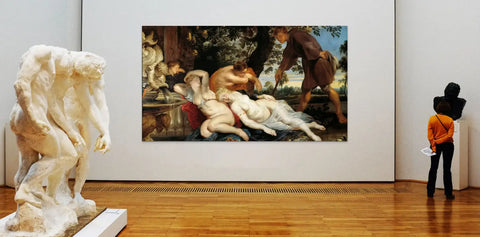
The goddess Aphrodite, associated with love and beauty, notably became one of the major subjects of ancient sculpture.
Artists then used the female body not only to represent a person, but also a deity, an ideal, or a mythological narrative.
The figure of Aphrodite
The goddess of love allows artists to work with the nude within a religious and mythological framework.
Search for harmony
The representation of the body is part of a search for proportions, balance, and idealized beauty.
The Renaissance: the return of the body and mythology
During the Renaissance, European artists widely rediscovered Greco-Roman culture. The human body once again becomes a central subject of creation.
The study of anatomy, perspective, and the pursuit of proportions occupy a considerable place.
Mythological scenes also offer painters a framework for representing the female nude.
Botticelli – The Birth of Venus
The figure of Venus becomes one of the most iconic images of the Italian Renaissance. Here, the body is associated with mythology, the ideal, and a form of visual poetry.
Titian – Venus of Urbino
The tradition of the reclining Venus becomes a major model for many European painters in the centuries that follow.
The nude becomes an artistic genre
Gradually, the study of the human body becomes an important step in artists’ academic training.
The nude woman in modern art: the gaze changes
From the 19th century onward, many artists began to question academic conventions.
The female body is no longer necessarily presented with the features of a goddess or mythological figure. It can represent a contemporary woman, a model, a real person, or simply become a way to explore forms and colors.
the nude woman gradually leaves the purely mythological realm to enter modern life.
Manet and the break with conventions
With Olympia, Édouard Manet creates a major break. The woman depicted looks directly at the viewer and no longer attempts to pass as an ancient goddess.
This frontality, along with the contemporary nature of the scene, contributed to the scandal caused by the work in its time.
Impressionism and intimacy
Artists such as Edgar Degas and Auguste Renoir also explore the female body, grooming, bathing, and intimate scenes.
Light, color, and movement gradually become just as important as anatomical representation.
Picasso, Modigliani and the distortion of the body
In the 20th century, artistic exploration moves even further away from traditional realism.
With Picasso, Modigliani, or other great modern artists, the body can be fragmented, elongated, simplified, or reconstructed.
The goal is no longer necessarily to faithfully reproduce a person, but to express an artistic vision.
The nude woman in contemporary art: identity, body, and freedom
Contemporary art has greatly expanded the ways in which the body can be represented.
Female nudity can now be used to question identity, beauty standards, aging, vulnerability, gender, power, or social representation.
The development of photography, performance, video, and digital art has also opened up new artistic territories.
The real body
Artists may deliberately move away from idealized beauty standards to show more diverse bodies.
Identity
The body becomes a way to question the construction of the self and society's gaze.
Artistic freedom
Nudity can be figurative, photographic, abstract, or simply suggested by a few lines.
What does the nude woman symbolize in art?
Of course, there is not just one meaning. The meaning depends on the period, the artist, the context, and the work.
Beauty
In many traditions, the female body has been used to represent an aesthetic ideal.
Fertility
Some ancient works associate femininity with birth, nature, or fertility.
Vulnerability
The absence of clothing can evoke fragility, intimacy, or self-exposure.
Sensuality
The nude can also explore desire, attraction, or human relationships.
Freedom
In some modern works, the body becomes a symbol of affirmation and emancipation.
Abstraction
The human silhouette can simply become a form, a line, or a volume serving the composition.
Why is the female nude in art still debated?
The representation of the nude woman is not only an aesthetic question. It also raises the question of the gaze.
For centuries, a large share of the works displayed in Western institutions were produced by men and intended for patrons or audiences who were also predominantly male.
From the 20th century onward, and especially with feminist movements, many artists and critics began to question this tradition.
who represents the body? For what audience? In what context? And is the person depicted the subject of the work or simply the object of the gaze?
This reflection profoundly transformed contemporary art. Many female artists have reclaimed control over the representation of the female body to speak about their own experience, identity, and freedom.
A few famous artists who explored the female nude
Sandro Botticelli
His Birth of Venus remains one of the most famous depictions of feminine beauty in Western art.
Titian
The Venus of Urbino profoundly influenced the representation of the reclining nude.
Diego Velázquez
With Venus at Her Mirror, he created one of the most famous female nudes in Spanish painting.
Édouard Manet
Olympia challenged the conventions of its time with its direct gaze and modernity.
Auguste Renoir
The Impressionist painter often explored the female body, color, and light.
Edgar Degas
His toilette and bathing scenes explore intimacy and everyday gestures.
Amedeo Modigliani
His nudes with elongated silhouettes have an instantly recognizable style.
Pablo Picasso
The female figure is omnipresent in his work, from figurative art to Cubism.
Auguste Rodin
His sculptures explore movement, the body, and the expression of emotion.
The artistic nude in interior decor
Today, of course, the female nude is no longer limited to museums.
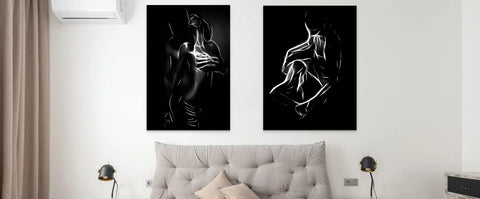
A female silhouette, a minimalist drawing, an abstract composition, or black and white wall art can become a true interior design feature.
In elegant decor
Black and white wall art is especially compelling in a contemporary interior. It allows you to play with silhouette and contrast while maintaining a refined atmosphere.
In modern decor
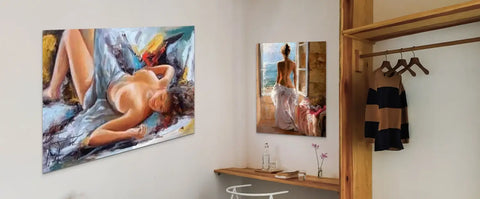
An abstract female portrait or a colorful representation can become the focal point of a living room, bedroom, or office.
In a more sensual atmosphere
A work suggesting a silhouette, curves, or intimacy can create warmer, more personal decor without necessarily being explicit.
Explore our collections around the female figure
Montableaudeco offers several worlds for bringing the female figure into your decor, from contemporary portraiture to abstraction and black and white.
What if the female figure became the statement piece in your decor?
Minimalist, sensual, abstract, contemporary, or black and white: each representation creates a different atmosphere.
Above all, choose a piece capable of sparking this reaction: “This is exactly the one I want on my wall.”
Discover the Woman collection Discover the Sexy collectionFAQ: the nude woman in art
Why have artists depicted nude women so often?
The female body has allowed artists to explore a wide range of themes: beauty, mythology, fertility, sensuality, vulnerability, identity, and social relationships.
How long has the female nude existed in art?
Representations of female figures date back to Prehistory. They later appeared in many civilizations, then came to occupy an important place in Greek art, the Renaissance, and modern art.
What is the difference between nudity and the artistic nude?
In artistic language, the “nude” traditionally refers to the representation of the human body as a subject of study or creation. The context, intention, and composition give meaning to the work.
Which artists are famous for their female nudes?
Botticelli, Titian, Velázquez, Manet, Renoir, Degas, Modigliani, Picasso, and Rodin are among the artists who worked on the representation of the female body.
Why did Manet's Olympia cause a scandal?
The work notably broke with the mythological conventions of the traditional nude. The woman depicted is clearly contemporary and looks directly at the viewer, which deeply disturbed part of the public at the time.
Is the female nude still present in contemporary art?
Yes, but its use is much more diverse. It can be used to explore identity, the relationship to the body, social norms, freedom, vulnerability, or simply artistic form.
Which woman wall art should you choose for modern decor?
An abstract portrait, a black-and-white silhouette, or a contemporary work is especially effective in a modern interior. The choice mainly depends on the colors of your room and the atmosphere you want to create.
Where should you hang wall art depicting a woman?
These works can fit beautifully in a living room, bedroom, office, or entryway. A large format can become a focal point, while a more understated composition blends easily into a wall gallery.
The nude woman in art: a theme that spans the centuries
From ancient sculpture to contemporary experimentation, the representation of the female body has never stopped evolving.
Each era has interpreted her through its own codes, ideals, contradictions, and questions.
Even today, women in art can be realistic, abstract, minimalist, powerful, fragile, sensual, or entirely reinvented.
It is precisely this diversity that makes the female figure such an enduringly fascinating artistic subject.
Discover our Woman wall art