
Who is Banksy, really? Clues, myths and messages in street art
In the world of street art, one name dominates every conversation: Banksy. An anonymous British artist, he has become world-famous without ever officially revealing his identity. His stencils combine humor, poetry and social commentary in just a few instantly recognizable lines.

But who is Banksy, really? What do we know about his origins, his technique and his most famous works? This guide examines the available clues, the theories that keep the mystery alive and the way his aesthetic continues to inspire contemporary wall decor.
Banksy: a ghost from Bristol

Banksy’s story is generally believed to have begun in Bristol in the 1990s. An industrial city with a vibrant music scene and a rebellious spirit, Bristol is also the birthplace of trip-hop and home to a particularly inventive graffiti scene. It was in this environment that the artist is thought to have created his first stencils, armed with a can of spray paint and a desire to challenge people’s perceptions.
His date of birth is often estimated to be around 1974. The name Robin Gunningham has frequently been suggested, but Banksy has never publicly confirmed it. Other observers believe he may be a collective rather than a single person. These theories fuel the legend but do not constitute definitive proof.
Ultimately, his identity matters less than his artistic vision. Banksy has become a living idea: a faceless signature capable of breaking free from the traditional conventions of the art market and bringing political reflection into public spaces.
The hallmarks of Banksy’s style: one glance, one message

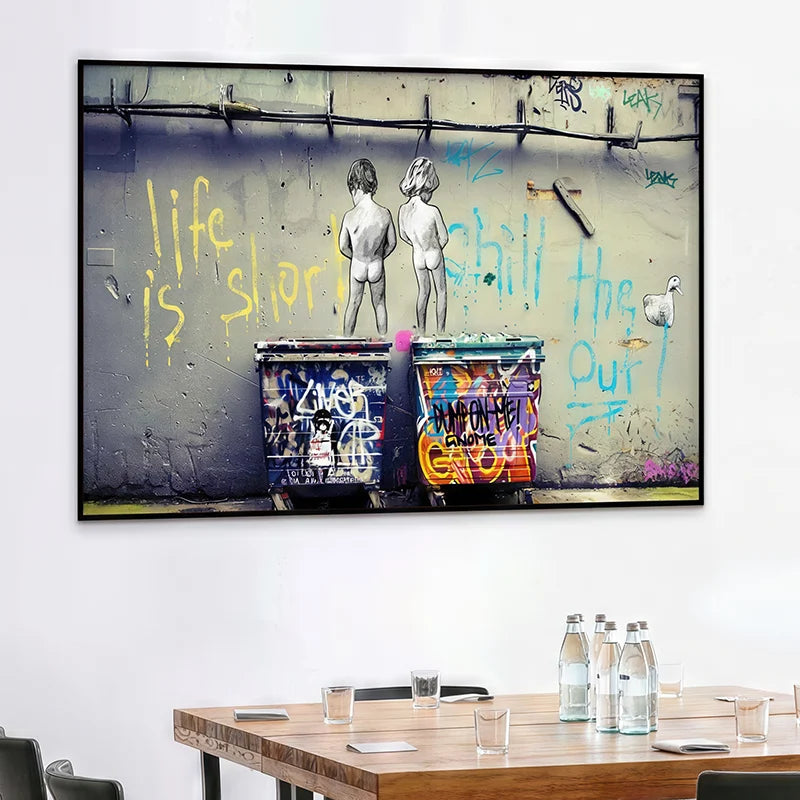
Banksy’s power lies first and foremost in his immediate visual clarity. Within seconds, viewers understand the scene and can already begin interpreting it. Children, soldiers, rats, monkeys and police officers appear on weathered walls, often in black and white. A single color — a red balloon, a flower or a fluorescent vest — then draws the eye.
Stencil art, a fast and precise technique
The stencil allows the artist to work quickly in the street. The shapes are prepared in advance, then transferred onto the wall in just a few movements. This technique explains the sharp silhouettes and striking contrasts. It also allows the artist to work discreetly, without turning the scene into a public performance.
A minimalist aesthetic in service of meaning
The compositions are rarely cluttered. A character, an object and sometimes a short phrase are enough. This economy of means resembles a visual haiku: the image appears simple, yet it offers several layers of meaning. Laughter often comes before reflection, and then the message lingers.
Banksy’s legendary works

Works attributed to Banksy are scattered across several countries. Some have disappeared, while others have been protected or relocated. The most famous motifs include:
- Girl with Balloon: a little girl reaches out toward a red heart-shaped balloon. The image can evoke innocence, hope or loss, depending on the viewer.
- The Mild Mild West: in Bristol, a teddy bear throws a Molotov cocktail at police officers. The scene sums up Banksy’s signature blend of tenderness and provocation.
- The rats: ever-present in his world, they symbolize unwanted beings that are agile and able to survive anywhere — a possible metaphor for the street artist himself.
- Laugh Now: a row of monkeys holds signs announcing that their time will come. The work subverts power dynamics with instantly understandable irony.
These images have moved beyond the confines of graffiti. They question consumerism, authority, war and compassion without relying on complicated rhetoric. This is the power of socially engaged street art: reaching a very wide audience, both in the street and in contemporary interiors.
Satire, humanism and irony: favorite themes
Banksy speaks out without sounding preachy. His works are political yet poetic. He mocks war, subverts symbols of the police, criticizes overconsumption and examines the mechanisms of power. Yet his perspective is not entirely dark: childhood, love and solidarity also hold an important place.
Children often represent perceptive witnesses to the adult world. Soldiers become vulnerable or absurd. Animals embody a freedom that humans seem to have lost. This contrast between a light-hearted scene and a serious subject creates a lasting emotional impact.
Why anonymity lies at the heart of his art
Anonymity is not merely a biographical detail: it is an integral part of the project. By refusing to reveal his face, Banksy shifts the focus to the image and the message. In doing so, he challenges an art world often built around signatures, fame and market value.
For more than twenty years, his appearances in public spaces have become events. The Israeli-Palestinian separation wall, London, Paris and New York have all hosted works that were later photographed, discussed and shared worldwide. Paradoxically, his silence sustains his extraordinary visibility.
Love Is in the Bin: the Sotheby’s masterstroke

On October 5, 2018, during an auction at Sotheby’s, Girl with Balloon partially shredded itself moments after it was sold. A shredder concealed in the frame sliced through the artwork before the eyes of the audience. The stunt, secretly planned in advance, became a performance against the art market, staged from within the system itself.
The wall art was then renamed Love Is in the Bin. Resold a few years later for nearly £19 million, it illustrates the Banksy paradox: a critique of market value can itself become an extraordinarily valuable event.
Exit Through the Gift Shop and the interplay of fact and fiction
In 2010, Banksy released Exit Through the Gift Shop. The film follows Thierry Guetta, a French filmmaker with a passion for street art, who becomes an artist under the name Mr. Brainwash. Presented as a documentary and nominated for an Oscar, the feature film blends personal accounts, satire and self-reflexive storytelling.
The viewer never knows exactly where reality ends and staging begins. This uncertainty extends Banksy’s exploration of authenticity, fame and the creation of artistic value in a society saturated with images.
The paradox between criticizing the market and commanding high prices
Banksy criticizes capitalism even as his works command record prices. This paradox does not undermine his message; on the contrary, it gives him fresh material. The artist plays with the system, caricatures it and turns it against itself.
He has thus become a kind of anti-brand brand: instantly recognizable, yet rooted in a rejection of conventional self-promotion. This tension explains why his work continues to fascinate street art enthusiasts, collectors and lovers of contemporary decor.
Why Banksy's art still resonates with us today
Banksy holds up a mirror to us. His works are funny, moving and sometimes unsettling, without requiring any knowledge of art history to understand them. In a single image, they capture a situation that others would take several pages to explain.
His art remains accessible to those who do not visit museums. It restores the street's role as a place for dialogue and reflection. This accessibility also explains why his visual language can now be found in posters, decorative canvases, framed art and gallery walls.
How to bring the Banksy aesthetic into your decor
Do you love the irony, contrast and energy of street art? You can bring its spirit into your interior without turning every wall into a mural. The aim is to create a strong focal point, then leave enough space around the image.
Choosing the right wall art and finish
- Large format: ideal above a sofa or sideboard, or in an entryway, to instantly add character to the room.
- Stretched canvas on wooden frame: a lightweight, artistic finish suited to contemporary decor.
- Plexiglass: a glossy surface that enhances contrast and creates a bolder graphic look.
- Black floating frame: a structured, gallery-style finish that highlights the image without overpowering it.
Coordinating colors and placement
A black, white and red palette echoes the iconic contrasts of urban stencil art. In a bright living room, black-and-white wall art with a pop of color creates an elegant focal point. In an office or entryway, a more energetic composition can complement minimalist furniture, black metal or natural wood.
| Room | Decor tip | Desired effect |
|---|---|---|
| Living room | A large-format piece above the sofa, paired with neutral walls. | Create an urban, contemporary focal point. |
| Entryway | A vertical piece or a well-lit floating frame. | Create an immediate sense of character. |
| Home office | A thought-provoking image near the workspace, without making it feel cluttered. | Encourage creativity and reflection. |
| Bedroom | A softer motif with a limited color palette, placed opposite the bed or to one side. | Maintain a calming atmosphere while adding a personal touch. |
Explore the Banksy wall art collection and the street art collection to compare the available sizes, materials, and styles. These pieces are decorative prints inspired by the world of street art, not original works attributed to or signed by Banksy.
Frequently asked questions about Banksy and street art
Do we know Banksy's true identity?
No. Several names have been suggested, including Robin Gunningham, but the artist has never officially confirmed any identity. These theories should therefore not be presented as established facts.
Is Banksy wall art sold as decor an original work?
No, unless it comes with proof of authenticity issued by a qualified organization. Decorative wall art and prints sold online use street art motifs or visual codes to enhance an interior; they are not original works by Banksy.
What size should you choose for street art wall art in a living room?
Measure the wall and the furniture below it. A large format generally works best above a sofa or sideboard, while a vertical format suits an entryway, hallway, or narrow wall. Leave enough space around the image to let it breathe.
How can you create Banksy-inspired decor without overwhelming the room?
Choose one striking piece, keep the walls fairly understated, and echo a few of its colors in the accessories. Lighting directed at the wall art and a simple frame are often enough to create a balanced gallery wall.
Conclusion: mystery as a work of art
Banksy is not just an artist: he is a living concept. By concealing his identity, he restored a sense of freedom and mystery to art. Every stencil, every action, and every silence contributes to a contemporary myth that is poetic, political, and popular.
“Art should comfort the disturbed and disturb the comfortable.” — Banksy
Perhaps Banksy's true face was never the main point. Perhaps it lies in the walls that speak, in the images that challenge us, and in this simple idea: art also belongs to those who look at it.