
Would you like to hang wall art without drilling into the wall? It is possible, provided you choose mounting hardware suited to the piece's weight, size, and the type of surface. Adhesive strips, hooks, magnets, and cables are designed for different needs.
This guide compares six methods for installing wall decor without visible holes. You will also find precautions to take in a rental, mistakes to avoid, and a table to help you quickly select the solution best suited to your interior.

Why hang wall art without drilling?
A no-drill mounting solution is especially appealing to tenants who want to leave behind a clean wall when they move out. It is also useful in an office, shop, or vacation rental where the decor needs to evolve. By moving a poster or small frame, you can refresh the atmosphere without filling holes, sanding, or repainting.
However, this solution does not mean “zero preparation.” The surface must be clean, dry, sufficiently smooth, and compatible with the chosen system. A freshly painted, dusty, damp, or textured wall, or one covered with delicate wallpaper, can significantly reduce adhesion. Always test on an inconspicuous area and follow the manufacturer's instructions.
1. Adhesive strips: a quick mounting solution for lightweight wall art
Removable adhesive strips are practical for a framed poster or small wall art whose weight remains within the limit stated on the packaging. Their slim profile stays hidden behind the piece and allows you to remove the wall decor without leaving a visible hook.
The right installation method
- Clean and dry the area with the product recommended by the manufacturer.
- Measure the placement and space the strips symmetrically.
- Press for the specified time, then wait the recommended period before hanging.
- When removing it, slowly pull the tab in the indicated direction, never toward you.
Avoid this method on delicate wallpaper, peeling paint, or a large stretched canvas whose weight exceeds the product's capacity. Temperature fluctuations, dust, and humidity can also weaken the hold over time.

2. Adhesive hooks: a simple option for a small frame
An adhesive hook is a good alternative when the wall art has a hanger on the back. It takes just a few minutes to install and allows you to move a small decorative piece as the seasons change. For modern decor, a lightweight piece displayed in an entryway or office is a good choice.
Precautions to take
- Choose the load rating specified for a single hook, not that of a similar model.
- Make sure the wall art hanger rests securely in the hook.
- Allow the adhesive to set according to the instructions before placing any weight on the support.
- Check the adhesion regularly, especially in a humid room.
Two hooks do not always double the allowable load: weight distribution, spacing, and wall quality also matter. If the frame is glazed, bulky, or installed above a high-traffic area, choose a more robust mounting solution.

3. The picture rail: flexible if a fixture is already in place
A picture rail provides a highly professional finish for creating a gallery wall. Adjustable cables and hooks allow you to move the artwork without drilling new holes for each position. It is an ideal solution if your home already has a picture rail, a sturdy rod, or a hanging system designed for this purpose.
Once the rail is in place, the wires can be adjusted in height, and the wall art can be aligned, layered, or grouped. However, check the maximum load capacity of the rail, cables, and hooks: the lowest limit applies to the entire system.

4. Magnetic hooks: for a truly metal wall
Magnetic hooks only work if the magnet sticks to the surface. Drywall, a painted wall, or plain concrete is not enough. This method is therefore better suited to a metal cabinet, steel backsplash, pegboard, or another compatible ferrous surface.
Before Hanging the Wall Art
- Test the magnetic attraction on an inconspicuous area of the surface.
- Check the hook's maximum load capacity in the position in which it will be used.
- Add a protective layer between the magnet and any scratch-sensitive surface.
- Avoid areas subject to impacts or vibrations.
The load capacity stated by the manufacturer often depends on the thickness of the metal and the direction of pull. Wall art hanging out from the surface does not behave like an object lying flat: allow a safety margin and check its stability after installation.

5. Nylon Thread or Rope: Hanging from an Existing Anchor Point
Nylon thread, thin rope, or coated cable can give your decor an airy look. This technique is truly drill-free only if an anchor point already exists: a picture rail, sturdy rod, load-bearing shelf, beam, or freestanding system.
Attach the wire to the fitting provided on the back of the wall art, make sure it remains perfectly vertical, and secure the end. For an arrangement of multiple frames, use adjustable lengths to maintain even lines. Never hang a heavy piece from a simple curtain rod if its load capacity is unknown.

6. The Tension Hanging System: A Freestanding Installation
Floor-to-ceiling tension systems use vertical posts or cables to support wall art. They can eliminate the need to drill into walls and are ideal for a rental, loft, or room with high ceilings. However, the system must rest on a floor and ceiling capable of withstanding its pressure.
Follow the manufacturer's installation instructions, check that the piece is level, and verify the combined weight supported by each hanger. Avoid an improvised setup using a simple rope stretched between two pieces of furniture. For a large piece, glass artwork, or a busy area, stability takes priority over visual appeal.
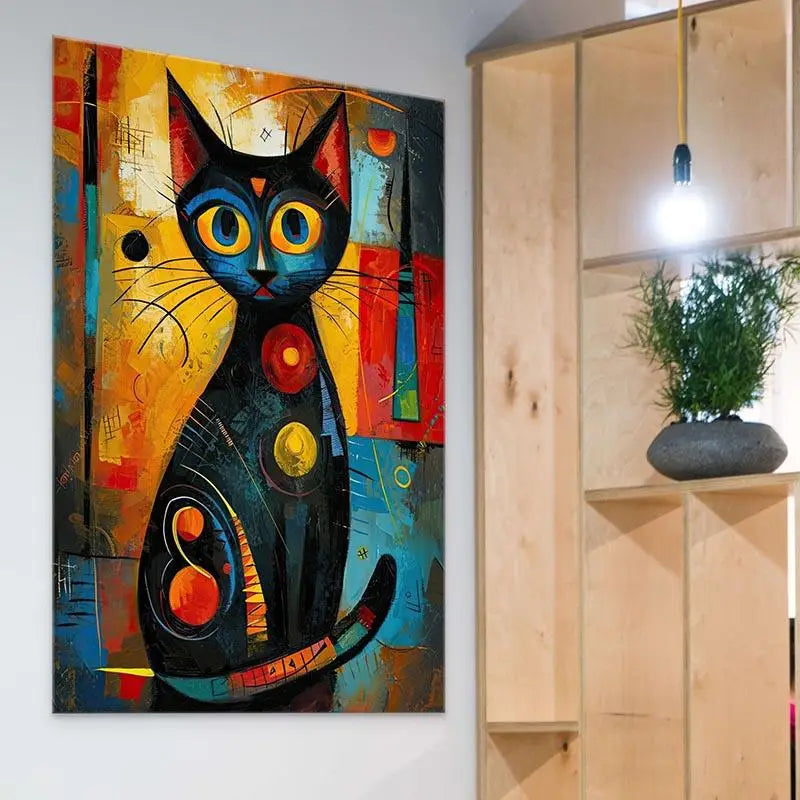
Which wall art should you choose? An unframed poster or a small, lightweight piece is generally easier to install without drilling than a floating frame or a large Plexiglass print. Explore the available sizes in our abstract wall art collection, then check the weight and hanging system of your chosen model.
How to Choose the Right Hanging System for Your Wall Art and Wall
Start by weighing the wall art with its frame and accessories. Next, identify the wall material: matte or satin paint, plaster, brick, concrete, metal, wallpaper, or tile. Finally, consider how the room is used: a mounting solution above a sofa should provide greater safety than one used for a small poster in a hallway.
| Solution | Best Suited For | What to Check Before Installation |
|---|---|---|
| Adhesive strips | Poster or small, lightweight frame, smooth wall | Weight, paint condition, and bonding time |
| Adhesive hooks | Small wall art piece with a hanger on the back | Hook weight capacity and attachment strength |
| Picture rail system | Flexible gallery wall if a mounting system already exists | Initial mounting, cables, and combined weight |
| Magnetic hooks | Steel or other ferrous metal surface | Actual magnetic force, weight, and scratch risk |
| Wire or cord | Lightweight to medium-weight wall art, existing anchor point | Anchor point strength and vertical alignment |
| Tension system | High-ceilinged room, freestanding floor-to-ceiling installation | Floor and ceiling compatibility and total weight |
For a large-format artwork, a canvas on a thick stretcher frame, or a glazed wall art piece, do not choose an adhesive mounting solution simply because it is discreet. Safety, stability, and the ability to remove the mount cleanly should guide your decision.
Inspiration: Decorate Every Room Without Drilling Holes in the Wall
Damage-free hanging is particularly convenient when your decor needs to evolve. In the living room, create a gallery wall with lightweight frames or use an existing picture rail. In a bedroom, choose a reliable mounting solution and avoid placing a heavy object above the headboard. In an office, an inspiring poster can be repositioned to suit the layout.
- Entryway: a small, lightweight wall art piece to create a focal point as soon as you walk through the door.
- Living room: an arrangement of coordinated sizes, within the weight limits.
- Bedroom: calming colors and secure mounting, away from areas where it could be knocked.
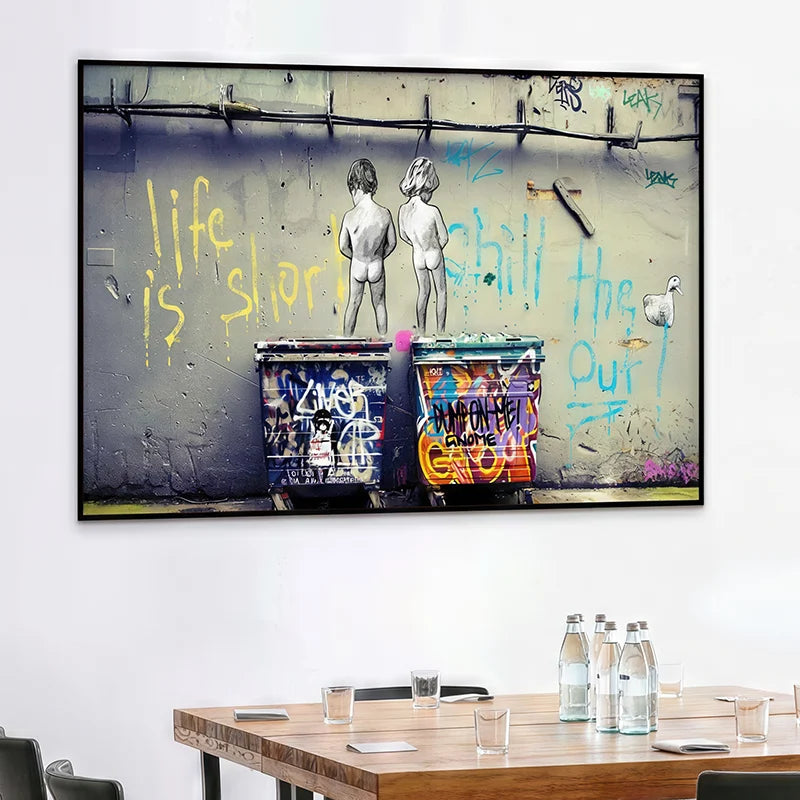
- Office: a graphic poster or street art wall art that can be easily repositioned.
- Kitchen: a mounting solution suitable for humidity and heat, positioned away from splashes.
To add character to a wall without overwhelming it, pair one statement piece with a few understated objects. Our selection of street art wall art can inspire an urban-style office or living room, while a softer arrangement fits easily into a bedroom.

Mistakes to Avoid for Successful Wall Decor
Most problems arise from underestimating the load or poorly preparing the wall. Take a few minutes to check the following points before hanging your wall art:
- Failing to weigh the complete artwork, including the frame and accessories.
- Applying adhesive to a dusty, damp, or crumbling surface.
- Mistaking a painted wall for a metal surface compatible with a magnet.
- Installing a picture rail while assuming it never requires mounting.
- Placing a heavy artwork above a sofa or bed without a safety margin.
- Removing a strip by pulling it toward you, which can tear off the paint.
- Using several different methods without checking alignment and visual harmony.
Before ordering wall art, also consider its placement, size, and medium. An unframed poster, stretched canvas, floating frame, or Plexiglass print will not have the same weight or hanging hardware. Always check the product details for the selected model.
Frequently asked questions about hanging wall art without drilling
Can you hang large wall art without drilling?
It is sometimes possible with a floor-to-ceiling system, an existing picture rail, or a freestanding support. Adhesive strips and hooks are only suitable if their maximum load actually covers the weight of the wall art, with a safety margin.
Do adhesive strips damage paint?
They are designed for clean removal, but no surface is guaranteed under all conditions. Follow the instructions, test in an inconspicuous area, and pull the tab in the recommended direction. Fragile or poorly bonded paint may peel off.
Does a magnetic hook work on a plasterboard partition?
No, not directly. You need a ferrous surface that can attract the magnet. On a plasterboard partition, choose an adhesive solution suited to the weight or a system that uses an existing fixture instead.
Is a picture rail really drill-free?
A standard picture rail generally needs to be attached to the wall or ceiling. It becomes a no-new-drilling solution if you reuse an existing picture rail, a sturdy rod, or a freestanding support.
Which hanging method should you choose for a rental?
For a small, lightweight piece of wall art, start with an adhesive hanging system suitable for the wall. For heavier decor or an evolving gallery wall, an existing picture rail or a freestanding floor-to-ceiling system is generally more suitable. Check the condition of the wall and the terms of your lease before installation.
Wall decor that evolves with your style
The right wall art starts with a size and medium suited to your room. Explore our modern wall art collection and prepare the space before choosing your hanging method.
Discover modern wall art