
British Street Art artists: the essential figures of urban art
From Bristol to the streets of London, Great Britain holds a major place in the history of Street Art and European graffiti culture.
Stencils, stickers, large-scale murals, minimalist portraits, collages, and graphic creations: British Street Art artists have developed very different visual signatures.
Banksy is, of course, the most famous name, but limiting British urban art to a single figure would be reductive.
Robert Del Naja, STIK, D*Face, Nomad Clan, and Frankie Strand illustrate the diversity of a scene where graffiti, Pop Art, music, activism, and popular culture come together.
Discover the artists, cities, and styles that have shaped British Street Art, along with our tips for bringing this urban energy into your interior decor.
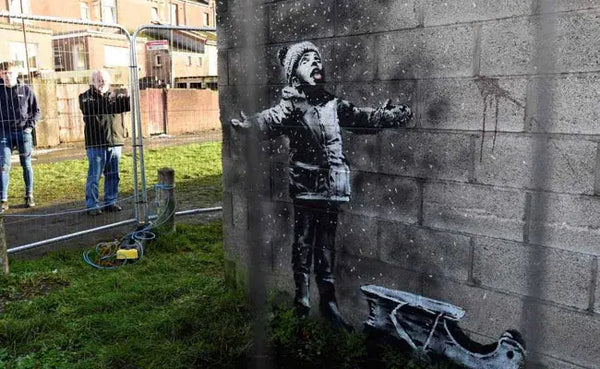
Banksy, STIK, D*Face, Robert Del Naja, Inkie, and several artists from the Bristol and London scenes are among the figures associated with the rise of British urban art. Their styles range from stencil work to graffiti, minimalist portraiture, collage, and Pop Art influences.
1. Great Britain and Street Art: a story of urban creativity
The British scene developed at the crossroads of several cultures: graffiti, punk, hip-hop, graphic design, music, posters, and underground culture.
London and Bristol, in particular, have seen many forms of urban intervention emerge, from simple tags to monumental murals.
One of the defining features of British Street Art is precisely this diversity.
Graffiti
Tags, lettering, characters, and colorful compositions represent the historical dimension of urban culture.
Stencil
A graphic technique especially associated with Banksy’s world.
Stickers & posters
They allow artists to quickly share their images across urban spaces.
Monumental murals
Large surfaces become compositions in their own right and transform architecture.
Pop Street Art
Advertising, comic books, music, and popular culture fuel highly graphic creations.
Engaged art
The street also makes it possible to address social, cultural, or political issues.
It is an ongoing dialogue between the street, music, imagery, and popular culture.
2. Bristol: an essential city in British urban art
When talking about British Street Art, Bristol holds a special place.
Its art scene is closely connected to various urban cultures, music, and graffiti.
It is notably within this environment that we find figures such as Banksy or Robert Del Naja, also known as 3D.
the city perfectly illustrates how graffiti, music, graphic design, and contemporary art can evolve within the same creative ecosystem.
3. Banksy: the invisible face of British Street Art
Banksy is probably the best-known British urban artist among the general public.
His identity has not been publicly established, which adds to the fascination surrounding his work.
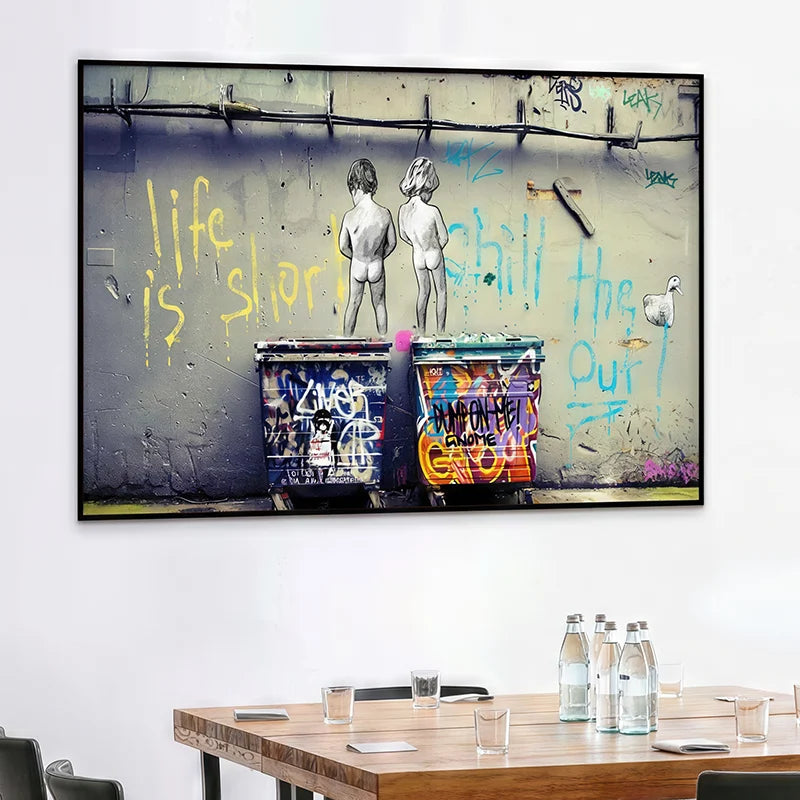
His visual language is especially associated with stencils, black and white, and the use of a few touches of color that instantly draw the eye.
Seemingly simple, his images often play on the contrast between poetry, humor, and social critique.
An immediate reading
The silhouettes and compositions are often designed to be understood in a matter of seconds.
A second reading
Behind the image, there may be a reflection on society, war, consumption, or freedom.
His visual language has also become highly prominent in wall décor.
4. Robert Del Naja: from graffiti to Massive Attack
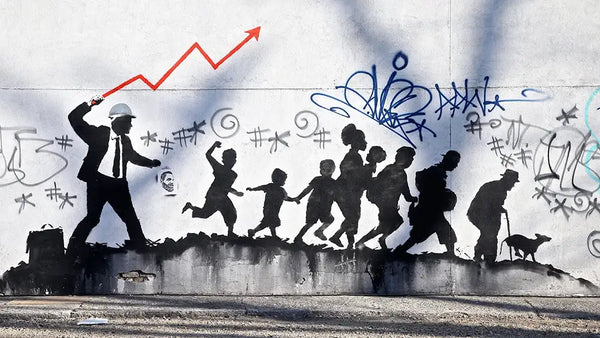
Robert Del Naja, also known by the pseudonym 3D, is closely connected to Bristol’s cultural scene.
Before and alongside his musical career with Massive Attack, he developed graphic work associated with graffiti, collage, and urban imagery.
His journey perfectly illustrates the close connection between British Street Art, music, and alternative culture.
Street Art does not exist in isolation. It engages with photography, graphic design, fashion, and especially music.
5. STIK: a few lines to express an entire emotion
STIK developed a signature style radically different from highly detailed graffiti compositions.
His characters are built from extremely simple shapes and lines.
This simplicity nevertheless allows them to express attitudes, human relationships, and different emotions.
STIK’s work is particularly linked to Hackney, in East London, where he began painting murals in the early 2000s.
A few lines can be enough to create an immediately recognizable identity.
6. D*Face: when Street Art meets Pop culture
With D*Face, urban culture meets advertising, comics, music, and Pop Art in a very direct way.
His work developed from drawings, stickers, and posters placed in public space.
His creations reinterpret the codes of popular culture with an aesthetic that is both colorful and deliberately subversive.
His official website now presents murals created in many cities around the world, including London, Paris, Lisbon, Tokyo, and New York.
Pop Art influence
Powerful colors, characters, and references to popular visual culture.
Urban influence
Stickers, posters, and murals maintain the connection with public space.
If you appreciate this blend of popular culture and urban art, discover our Pop Art Wall Art collection .
7. Nomad Clan: British Street Art on a very large scale
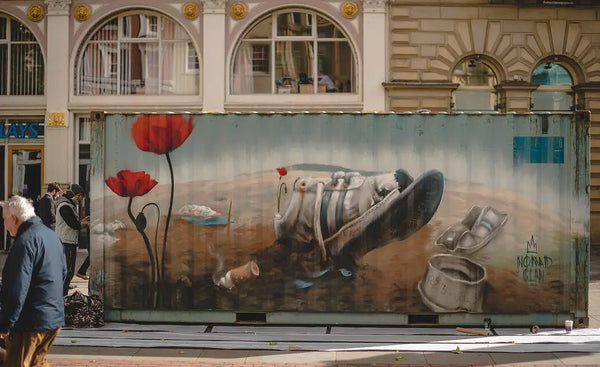
The duo Nomad Clan, formed by Cbloxx and Aylo, is known for its large-scale murals.
Their work reveals another facet of Street Art: one where the artist must take into account the architecture, the history of the place, and the scale of the building.
The mural is no longer simply placed on a wall: it transforms the perception of the building itself.
8. Frankie Strand: animals, biodiversity, and colors in East London
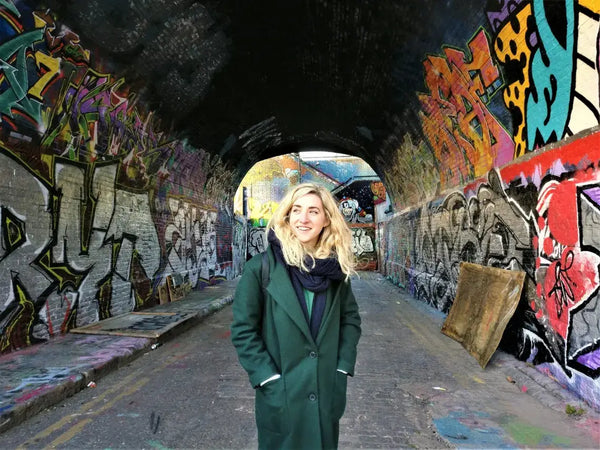
The British scene is not limited to political messages or abstract compositions.
Frankie Strand notably develops a universe inspired by wildlife and animal forms.
This approach once again shows the diversity of contemporary muralism: an urban wall can evoke society as much as nature, biodiversity, or the imagination.
9. What are the major styles of British Street Art?
| Style | Features | Associated universe |
|---|---|---|
| Stencil | Silhouettes, contrast, direct message | Banksy, minimalist interior |
| Graffiti | Tags, lettering, colors, projections | Urban and industrial decor |
| Urban minimalism | Simple shapes and silhouettes | STIK, contemporary decor |
| Pop Street Art | Comics, advertising, popular culture | D*Face, Pop Art |
| Muralism | Monumental murals | Nomad Clan, large formats |
| Collage & graphic design | Layering, images, and typography | Musical and alternative culture |
To bring the codes of urban walls into your interior, explore our Graffiti Wall Art collection .
10. How to incorporate British Street Art into your interior décor?
The energy of the streets of London or Bristol can fit perfectly into a living room, bedroom, office, or gaming space.
The aim, however, is not to recreate a complete urban wall.
A single bold artwork can be enough.
White or beige living room
You can choose a highly colorful or contrasting creation.
Industrial living room
Black, red, graffiti, and stencil work very well with metal, concrete, and dark wood.
Minimalist interior
A Banksy composition or a more monochrome artwork can create an elegant focal point.
Gaming room
Graffiti, Pop Art, and urban culture naturally fit this universe.
Office
A graphic and dynamic artwork can add more character to the workspace.
Large wall
An XXL or panoramic format lets you capture some of the visual power of an urban fresco.
if your wall art is already very colorful, keep the surrounding furniture relatively understated. The artwork can then naturally become the focal point of the room.
Explore this entire universe in our Street Art Wall Art collection .
11. Canvas, floating frame, Plexiglass or poster for Street Art wall art?
Frameless poster
A simple, lightweight finish, close to the spirit of urban posters.
Stretched canvas
It brings a more artistic look and suits highly graphic compositions.
Black floating frame
It accentuates contrasts and gives a particularly bold finish.
White floating frame
Brighter, it helps lighten a highly colorful composition.
Plexiglass
Its glossy finish enhances color intensity and creates a contemporary look.
Explore our Street Art universe
From stencil to graffiti, from Banksy to Pop Art, several worlds bring urban culture into your décor.
Want to bring the energy of London and Bristol into your home?
You don’t need to transform your entire interior.
A well-chosen Street Art wall art piece can be enough to give a wall a new personality.
Stencil, graffiti, Pop Art, or urban composition: find the style that feels like you.
Discover Street Art Wall Art View Banksy Wall ArtFAQ: British Street Art artists
Who is the best-known British Street Art artist?
Banksy is now one of the British Street Art artists best known to the general public, particularly thanks to his stencil works and the mystery surrounding his identity.
In which British city is Street Art especially present?
London and Bristol have particularly important urban art scenes. Bristol is notably associated with Banksy and Robert Del Naja.
Which London Street Art artists should you know?
STIK and D*Face are among the names associated with the London scene, alongside many graffiti artists, muralists, and contemporary artists.
What technique does Banksy use?
Banksy is particularly known for his use of stencils, often associated with black-and-white compositions with a few touches of color.
Is Robert Del Naja a Street Artist?
Robert Del Naja, also known as 3D, is connected to Bristol’s graffiti scene and has an artistic practice alongside his role in Massive Attack.
Which Street Art wall art should you choose for a living room?
In a bright or neutral living room, you can choose colorful or graffiti wall art. In a more minimalist room, black-and-white Banksy wall art can create an elegant contrast.
What is the difference between Street Art and graffiti?
Graffiti is one of the practices of urban culture. Street Art also includes stencils, posters, collages, murals, and other forms of artistic intervention in public space.
Which medium should you choose for modern Street Art décor?
Stretched canvas offers an artistic finish, the black floating frame enhances contrasts, and Plexiglass adds a glossy, contemporary finish.
British Street Art: much more than Banksy
Banksy has played a major role in popularizing British urban art among the general public.
But behind this iconic figure lies a much broader scene.
Bristol, London, and other cities have brought forth artists with radically different worlds: minimalism, graffiti, murals, Pop Art, music, or socially engaged creation.
It is precisely this diversity that makes British Street Art so rich: the same wall can become, in turn, a message, an image, a story, or an explosion of color.
Explore the world of Street Art