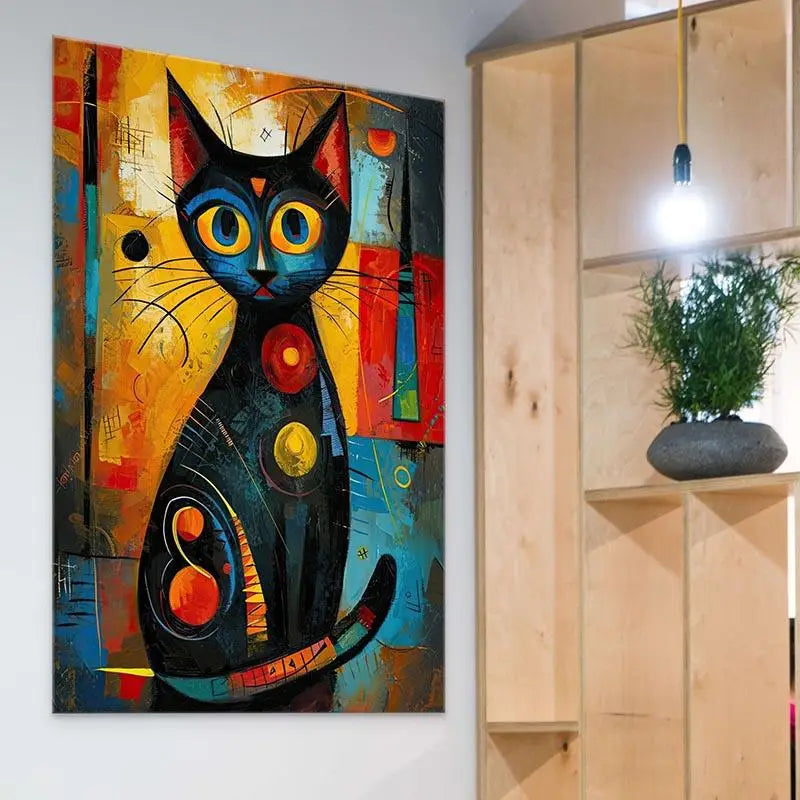

In this blog category, you will discover a little more about the abstract painting and its evolution, and you will be able to meet artists famous abstract artists. You will learn the history of abstract art, and of course, the names of artists who were pioneers of abstract art and the presentation of contemporary abstract art.
If you are looking for a famous abstract painting, you will probably find it in this section of my blog.
If you are searching for an abstract artist to decorate your home, visit our collection of abstract paintings
About abstract painting
The abstract painting is different from figurative painting in that this type of art does not seek to represent reality but encourages the viewer to focus on their feelings. It is a type of non-representational art today that creates an emotional and visual experience. Theabstraction therefore opposes figuration. Figurative paintings can be seen in a variety of older paintings as well as in museums. These are paintings composed of a scene or a person, for example... whereas in a abstract work, the artist does not seek to represent reality. This type of art is a way to explore one's own feelings. Created toward the end of the 19th century, the abstract painting experienced a resurgence in art, even though at first, this type of painting was highly contested. Today, abstract painting is very sought after and much appreciated, and it can be seen in art galleries, as well as in various private collections.
The history of abstract painting
Some artists like Degas, Pissarro, or Monet were not invited to the artists' salon because they were not considered figurative artists but rather abstract artists. They did not necessarily conform to the academic standards of their time. The aim of the artists was to express their emotions, without seeking to represent the real world on canvas. Vasily Kandinsky is considered the innovator of theabstract art and we generally associate abstraction with the artist. Kazimir Malevich, Kupka, as well as Piet Mondrian are all remarkable painters in the world of abstraction. In 1910, Kandinsky published his work entitled "Concerning the Spiritual in Art and in Painting in Particular", in which he explains that abstract painting is for him a spiritual art. A few years later, the concept of "abstract watercolor" was created. Thus, abstract art was created as a new type of painting that touches us all through its sensitivity. Later, other abstract paintings were created, such as the famous "Black Square on White Background" in 1915, and the "White Square on White Background" in 1918 by artist Kazimir Malevich. The artist later declared that his ideology was Suprematism. Lyrical abstract painting is also a result of 1912 due to "The Painting of the Black Arch" by Vassily Kandinsky, as it is executed in music.
The artist Kandinsky had synesthesia, which is the ability to represent music through color. The combination of sound and music allows the artist to create harmonious compositions through the use of shapes and colors. In contrast to lyrical abstract paintings, geometric abstraction also witnessed the dawn of a new era. This is a form of art that relies mainly on geometric patterns. The combination of lines, circles, and triangles, as well as squares, is also experiencing a revival in the art world, and furthermore, the artist Mondrian later focused his work mainly on using right angles. In the development of abstraction, Robert and Sonia Delaunay also stand out as pioneers in their art, which the renowned poet Apollinaire would later call Orphism. Orphism is named in honor of the mythological figure Orpheus, as well as the title of the poet's works. Orphism is more the lyrical form of abstraction than geometric abstraction. Abstract painting made the subject perceptible, but a different language emerged, such as emotion and the senses. Today, modern art gives a wonderful place to abstract art.