
Jean-Michel Basquiat is one of the most influential figures in urban art and 20th-century contemporary painting. Under the pseudonym SAMO, he began by writing enigmatic phrases on the walls of New York before developing a visual language of words, symbols, figures and raw colours across canvas and other surfaces.
His journey cannot be summed up as that of a graffiti artist who became famous. Basquiat brought street culture into dialogue with art history, jazz, African American culture and debates about power. In just a few years, he helped change perceptions of graffiti and artists from New York’s alternative scene. Here are the key stages and ideas for understanding his influence.
Basquiat, street art and contemporary art: understanding his journey
Basquiat is often described as a street artist, but this label does not fully capture his work. He began in public spaces with SAMO, then worked primarily on paper, canvas and found materials. His painting also belongs to the New York neo-expressionist scene of the 1980s, while retaining a graphic energy rooted directly in the street.
This dual identity explains his uniqueness. From graffiti, he borrowed its urgency, signature style and direct appeal to passersby, while also creating complex compositions shaped by historical, anatomical, musical and political references. Speaking of the “legitimization of street art” is therefore useful for understanding his impact, provided Basquiat is not reduced to a mere precursor of graffiti-inspired decor.

Basquiat’s origins: from Brooklyn to SAMO
Jean-Michel Basquiat was born in Brooklyn in 1960 to a family of Haitian and Puerto Rican heritage. This cultural diversity shaped his relationship with language, historical narratives, and representations of the Black American community. From an early age, he developed an interest in drawing, books, anatomy, and imagery from popular culture.
In the late 1970s, he formed the SAMO project with Al Diaz. The name is generally understood to stand for “Same Old Shit” and appeared alongside brief, ironic, or enigmatic phrases written across Manhattan. SAMO was more than just a signature: it was a way of commenting on religion, commerce, institutions, and power dynamics in very few words.
- Short phrases that interrupt the everyday landscape.
- Ambiguous words open to multiple interpretations.
- A blend of social criticism, poetry, and dark humor.
- An ephemeral presence, shaped by the wall and its surroundings.

The rise of street art in New York in the 1970s and 1980s
New York during this period is a cultural laboratory. Graffiti, punk, music, dance, clubs, and alternative galleries converge in the same neighborhoods. Walls, subways, and abandoned spaces become platforms for expression for artists seeking to bypass traditional art-world channels.
Basquiat moves through this environment without confining himself to the conventions of lettering. His symbols and texts engage in dialogue with the work of Keith Haring, Kenny Scharf, and other artists from the downtown scene. The aim is not to replace gallery painting with graffiti, but to show how the two worlds can inspire one another.

SAMO: graffiti as an act of rebellion and urban poetry
With SAMO, Basquiat and Al Diaz transform the wall into a space for reflection. The messages do not always offer a clear answer: they provoke, surprise, and invite passersby to complete the meaning. This economy of means foreshadows several elements that would later appear in Basquiat’s wall art: crossed-out words, repetitions, symbols, arrows, and unexpected associations.
The project ends in the early 1980s, when the phrase “SAMO is dead” signals the disappearance of the alter ego. Basquiat can then sign his own name and develop a broader practice. The end of SAMO does not mean abandoning the street: it marks a transition to a different medium and a wider scale of exposure.
- The word as image: text has rhythm, density, and a graphic presence.
- The symbol as shorthand: a crown, skull, or figure can encapsulate several ideas.
- The wall as context: the architecture and the movement of local residents shape how the work is interpreted.

From the streets to galleries: newfound visibility for Basquiat
In the early 1980s, Basquiat attracts the attention of curators, gallerists, and collectors. His participation in the Times Square Show in 1980 helps bring him recognition beyond the alternative art scene. Other exhibitions and encounters quickly follow, while his painting retains the intensity and freedom of his earliest inscriptions.
The move into galleries is ambivalent. It gives Basquiat space, resources, and an international audience, but also exposes him to the mechanisms of an art market that turns artworks into objects of value. This tension between recognition and commercial appropriation remains essential to understanding the significance of his work.
His collaborations with Andy Warhol increase his visibility without erasing the differences between their practices. Basquiat brings free-flowing gestures, historical references, and social commentary; Warhol comes from a culture of screen printing, repetition, and media imagery.

Basquiat's style: a fusion of graffiti, painting, and scholarly references
Basquiat's style is recognizable by its apparent spontaneity. Yet his wall art is built up in layers: words, silhouettes, anatomical forms, fragments of text, signs, blocks of color, and scratched marks echo one another. Some areas appear quickly executed, while others are reworked, concealed, or rendered almost illegible. This coexistence of the visible and the erased gives the surface a powerful tension.
The crown is one of the best-known motifs in his visual language. It can evoke grandeur, recognition, or power, but its interpretation depends on the context of the wall art. Skulls, bodies, and anatomical diagrams, meanwhile, evoke human fragility and power dynamics.
Basquiat also uses a variety of surfaces, some of them reclaimed. Doors, panels, and irregular materials retain traces of the urban environment. The surface is therefore not neutral : it contributes to the materiality and history of the work.
- Energetic gestures and deliberately imperfect lines.
- Layers of text, drawing, symbols, and texture.
- Contrasts between vibrant colors, black, white, and scratched areas.
- References to history, anatomy, sports, jazz, and street culture.

Key themes : identity, injustice, and popular culture
Basquiat’s work explores the representation of Black people, colonial legacies, power, fame, and social violence. These subjects are not treated as mere illustrations : they emerge through fragmented words, anonymous figures, historical references, and signs that sometimes contradict one another.
Identity lies at the heart of this exploration. Basquiat questions how institutions name, classify, and perceive Black bodies. He also claims his place in art history by bringing his figures into dialogue with scholars, athletes, musicians, and historical figures.
Social criticism blends with a reflection on consumerism and the art market. His wall art can captivate with its colors and energy while creating unease through themes of death, exploitation, and inequality. This coexistence of visual appeal and intellectual discomfort gives it lasting power.
- Identity and representation : who is visible, who is named, and who is forgotten ?
- Power and resistance : which figures dominate, and which voices are erased ?
- Popular culture : how do music, sports, television, and advertising shape our collective imagination ?
- Life and mortality : how do the body, skull, and anatomy convey a sense of fragility ?

Music in Basquiat's World: Jazz, Hip-Hop, and Urban Rhythms
Music shapes Basquiat's visual thinking. Jazz, particularly figures such as Charlie Parker and Miles Davis, represents a form of freedom, improvisation, and construction through fragments for him. His musical references are not mere tributes: they become symbols connecting Black history, creativity, and resistance.
Hip-hop emerged in the same New York where Basquiat developed his career. Both cultures share street energy, sampling, repetition, and the transformation of existing materials. It is more accurate to speak of a shared cultural context than to claim that every element of his style came directly from hip-hop.

Basquiat, Andy Warhol, Keith Haring: An Art Scene in Dialogue
Basquiat's encounter with Andy Warhol holds an important place in his biography. Between 1983 and 1985, they created works together that bring screen printing, logos, painted gestures, and each artist's signature figures into dialogue. These collaborations are neither a complete fusion nor a simple combination of styles: they reveal two artists testing their differences on the same surface.
Keith Haring and Kenny Scharf are also part of Basquiat's artistic circle. Exchanges between studios, clubs, musicians, and galleries help create a scene where disciplines intersect. This New York dynamic explains why the history of street art cannot be told solely through individual careers.
- Warhol brings a reflection on media imagery and repetition.
- Haring shares a graphic practice directly connected to public space.
- Scharf contributes to the fusion of painting, popular culture, and music.
- Basquiat retains a personal, political, and deeply material visual language.

Basquiat's Impact on Contemporary Street Art
Basquiat helped open cultural institutions to practices emerging from the streets and alternative scenes. His career demonstrated that urban visual language could become sophisticated painting without losing its critical power. This visibility has inspired artists working today in graffiti, murals, collage, illustration, and performance.
His influence can also be seen in fashion, music, graphic design, and interior decor. However, inspiration must be distinguished from direct imitation. Drawing on a vibrant palette or gestural composition does not grant permission to copy a painting, use a signature, or present a reproduction as an original work.
The official website dedicated to Jean-Michel Basquiat's legacy offers a timeline and documentary resources. For thorough research, always cross-check biographical information with museum, foundation, or collection sources.

Draw inspiration from Basquiat for your wall decor
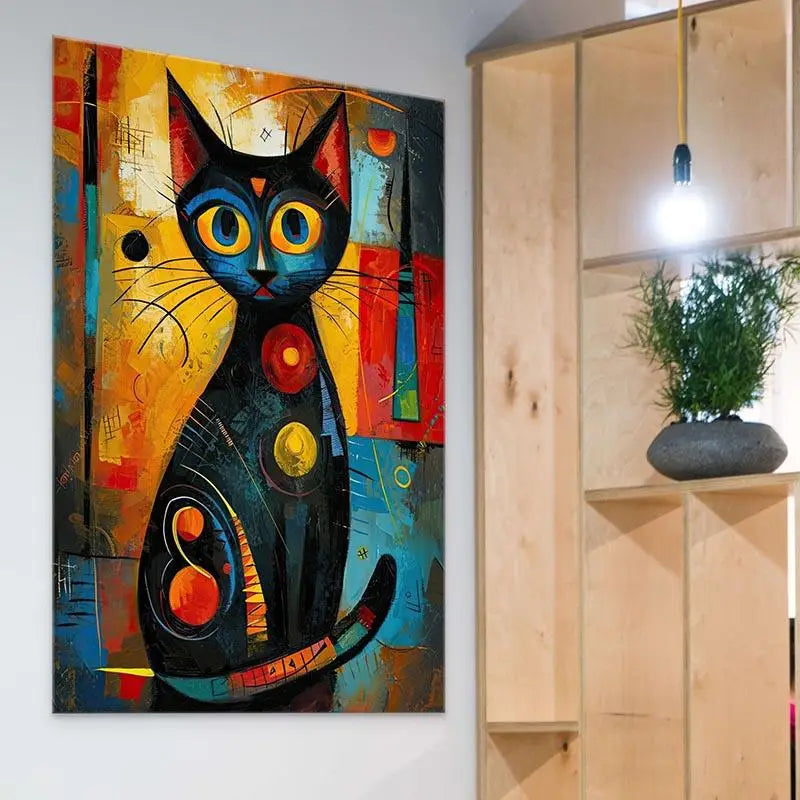
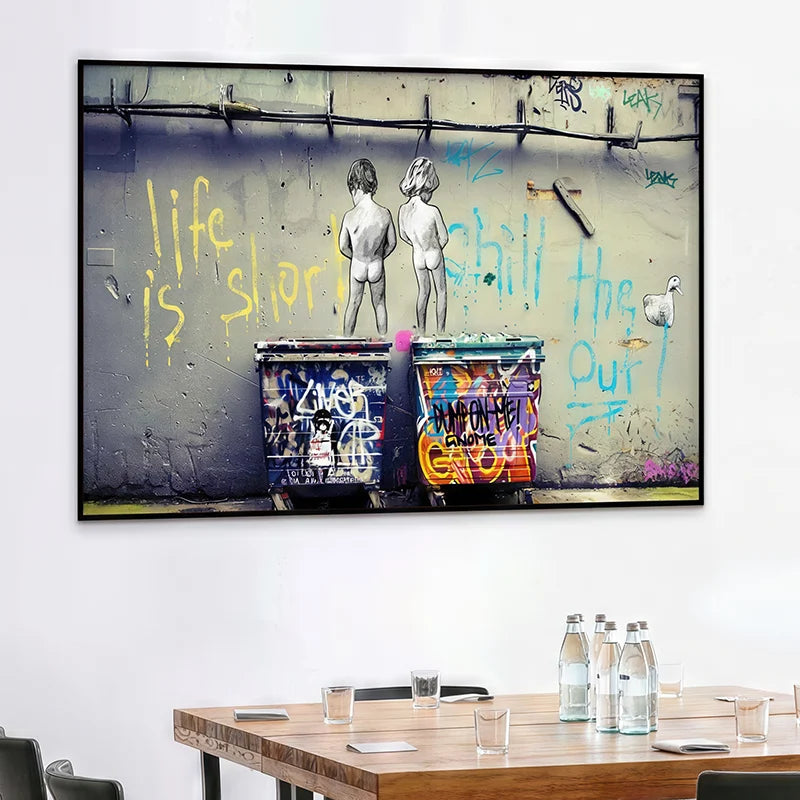
A Basquiat-inspired wall art piece can add character to a living room, office, or bedroom. For a balanced look, choose one statement piece and pair it with more understated walls, a sofa, and accessories. A palette of black, white, yellow, red, or blue can evoke the energy of street art without overwhelming the room.
Choose the format and medium
Measure the wall and allow enough viewing distance to appreciate the details. A large format works well above a sofa, while a more compact format fits easily in an entryway or office. Depending on the design, compare an unframed poster, stretched canvas, black or white floating frame, and Plexiglass print in the Montableaudeco street art collection.
Create a cohesive look
Echo one or two colors from the wall art in textiles or decorative objects. Light wood adds warmth to a highly contrasting composition, while black furniture highlights its graphic quality. To explore a broader aesthetic, discover our Pop Art wall art and modern wall art.
A decorative print inspired by Basquiat is not an original painting, signed edition, or authenticated work by the artist. Check the image, material, dimensions, and product details before ordering. For more inspiration, see our article on incorporating urban art into your décor.
Frequently asked questions about Jean-Michel Basquiat
Why is Basquiat associated with street art?
He began in public spaces with the SAMO project, then brought the writing, symbols, and urgency of graffiti to paper and canvas. His career helped bridge urban art, contemporary painting, and cultural institutions without being confined to a single category.
What does SAMO mean?
SAMO is the pseudonym used by Basquiat and Al Diaz in the late 1970s. It is generally understood to stand for “Same Old Shit” and appeared alongside critical, poetic phrases written across Manhattan.
What are Basquiat's best-known motifs?
Crowns, skulls, bodies, words, arrows, and diagrams appear frequently. Their meaning depends on the work and its context, so it is best not to assign them a single, definitive interpretation.
Did Basquiat really work with Andy Warhol?
Yes. The two artists created a series of paintings together in the mid-1980s. These works bring Warhol's screen printing and media imagery into dialogue with Basquiat's expressive gestures, symbols, and figures.
Can you buy an original Basquiat work online?
An original work or authenticated edition must come with provenance and authentication documents. A decorative print inspired by his artistic world falls into a different category: read the seller's description carefully before purchasing.
How can you incorporate Basquiat-inspired wall art into a living room?
Choose an uncluttered wall, a size that suits the furniture below, and a palette featuring no more than two or three colors from the room. A minimalist frame and indirect lighting will preserve the visual impact without overwhelming the space.
Add character to your walls
Bold colors, graphic symbols, and urban energy: explore the Montableaudeco selection to find street art that complements your interior.
Discover the street art collection