
The rise of street art in New York: history, artists, and legacy
In the 1980s, New York became one of the world’s leading hubs for urban art. Its walls, subway cars, and streets were transformed into canvases for self-expression. In a city shaped by inequality, social tensions, and extraordinary cultural energy, graffiti gave a voice to a new generation of artists.

Basquiat, Keith Haring, Futura 2000, and Lady Pink helped drive this transformation. Their work gradually moved beyond the streets and into galleries, media, and collections. Even today, their legacy continues to inspire contemporary artists and street art wall art that finds a place in our homes.
1. New York in the 1980s: the context that gave rise to a movement
The 1980s were a complex time for New York. Some neighborhoods faced poverty, unemployment, crime, and significant urban decay. Yet abandoned buildings, vacant lots, and transportation infrastructure provided vast surfaces for artists seeking new ways to express themselves.
This situation creates a powerful contrast: the city is going through difficult times, yet its young people are creating an extraordinarily inventive culture. Walls become spaces for dialogue, protest, and visibility. Artists do more than simply decorate a neighborhood: they tell the stories of what they experience and observe.
- The rise of hip-hop culture and its artistic practices.
- The availability of large urban spaces, whether unused or neglected.
- Young people searching for new forms of expression.
- Social and racial tensions that shape the messages conveyed by the artworks.

2. Graffiti and street art: origins and differences
Graffiti is one of the major roots of New York street art. From the 1960s onward, young artists used walls, subway cars and tunnels to inscribe a name, signature or lettering. The practice then evolved through the use of spray paint, lettering styles, colors and increasingly ambitious compositions.
Street art broadens this approach. It encompasses murals, stencils, collages, stickers and other forms of intervention in public spaces. The message may be personal, political, humorous or simply visual. The two practices are related, but they do not always share the same purpose.
| Criterion | Graffiti | Street art |
|---|---|---|
| Purpose | Assert a name, signature or graphic identity. | Convey a message, an emotion or commentary on society. |
| Techniques | Spray paint, lettering, outlines and layers of color. | Stenciling, mural painting, collage, sticker art and mixed media. |
| Audience | A community that recognizes the codes and signatures. | A broader audience, often struck by the image or message. |

3. The Bronx, Brooklyn and Manhattan: iconic neighborhoods
The Bronx, birthplace of hip-hop
The Bronx is often described as one of the birthplaces of hip-hop. At block parties, DJs, MCs, dancers and graffiti artists developed a shared culture. Damaged walls became vibrant surfaces where music, movement and visual identity came together.
Brooklyn, a laboratory of styles
Brooklyn provides an ideal environment for experimentation. Its bohemian atmosphere attracts artists who blend techniques and influences. Murals, collages and colorful compositions reflect a desire to create an open artistic community.
Manhattan, an international showcase
With its busy streets, high-rise buildings and iconic neighborhoods, Manhattan gives street art exceptional visibility. The works are seen by residents, the media and visitors from around the world. This exposure helps urban art move beyond its local setting.

4. Basquiat, Haring and the pioneers of New York street art
Several artists helped change perceptions of street art. Their work extends beyond walls, entering galleries, books, collections and the history of contemporary art.
Jean-Michel Basquiat
Jean-Michel Basquiat developed a dense visual language composed of words, symbols, crowns and figures. His works explore identity, power, history and social tensions. His career shows how an art form born on the street can engage with painting and the art market without losing its critical edge.
Keith Haring
Keith Haring stands out for his simple silhouettes, energetic lines and instantly recognizable characters. The subway and public spaces allowed him to reach a wide audience. His images explore themes such as solidarity, freedom, health and social issues.
Futura 2000 and Lady Pink
Futura 2000 helped steer graffiti toward more abstract compositions. Lady Pink, meanwhile, holds an important place in a scene long portrayed as male-dominated. Alongside other artists, they show that urban art is a collective movement in constant evolution.
- Jean-Michel Basquiat: symbols, words and social commentary.
- Keith Haring: dynamic lines and iconic figures.
- Futura 2000: abstraction, depth and experimentation.
- Lady Pink: murals, characters and the affirmation of a female voice.


5. Techniques, materials and stylistic evolution
The spray can remains graffiti's iconic tool. It allows artists to work quickly, cover large surfaces and create gradients or precise outlines. Artists also use stencils, rollers, markers and brushes to vary textures and levels of detail.
Layering adds depth. Collage introduces fragments of newspapers, photographs or typography. Abstraction, portraits and political messages gradually enrich the visual language of New York street art.
- Spray paint for solid areas of color, outlines and gradients.
- Stencil to reproduce a silhouette or symbol.
- Roller and brush for large surfaces and fine details.
- Collage and printed patterns to combine image, text and texture.

6. The influence of hip-hop and other art movements
Hip-hop gives street art a soundtrack, a rhythm and a philosophy. DJs, MCs, dance and graffiti thrive in the same places and share a desire to create with limited resources. This close connection explains the strength of New York's cultural identity in the 1980s.
Other movements also inspire urban creativity. Pop art influences its vibrant colors, product references and repetition of images. Abstract expressionism encourages a more gestural approach, where texture and movement take precedence over representation.

7. Galleries, media and institutions: the recognition of street art
The transition from the street to galleries changes how urban art is perceived. Exhibitions give artists new surfaces, new audiences and more lasting conservation conditions. This recognition does not diminish the energy of the street, but opens up a dialogue between popular culture, contemporary art and the art market.
Articles, news reports and documentaries also play an essential role. They spread images beyond New York and bring visibility to the artists, their techniques and their messages. Street art thus becomes a global cultural phenomenon rather than simply neighborhood decoration.

8. Reactions, controversies and impact on the city
Street art has always sparked mixed reactions. For some, it represents a legitimate form of artistic freedom; for others, unauthorized works are an act of vandalism. New York authorities have sometimes sought to remove graffiti, fueling debate about ownership, legality, and the preservation of artworks.
The impact on urban communities also remains complex. Murals can bring renewed visibility to a neighborhood and make it more appealing. They can also accompany property development and gentrification that gradually displaces long-standing residents. This tension is part of street art's history: beautifying the city while questioning power structures.

9. From New York to Banksy: a global legacy
The creative energy of 1980s New York quickly inspired artists around the world. Techniques, colors, and a spirit of resistance spread far and wide. Festivals, urban art trails, and events dedicated to mural art emerged in many cities.
Banksy exemplifies this global reach. The anonymous British artist uses stencils, satire, and instantly recognizable scenes to question war, consumerism, and inequality. His work engages with the legacy of New York urban art while remaining distinct from that of Basquiat or Haring.
To explore this topic further, read our article on Banksy and pop culture, and browse our selection of street art wall art.

10. Bring the New York spirit into your decor
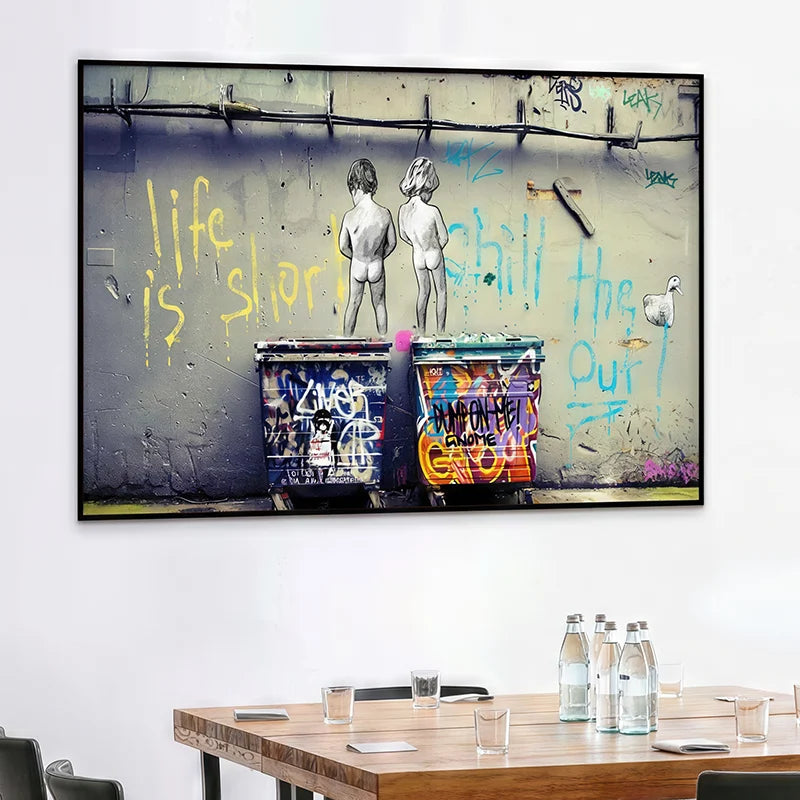
The history of street art can also inspire contemporary wall decor. Graffiti wall art, pop art canvas prints, or portraits featuring urban colors become focal points in the living room, office, or entryway. To create a warm atmosphere, pair the colors of the artwork with simple materials: light wood, linen, black metal, or leather.
Ideas for creating an urban gallery wall
- Choose a large piece of wall art as a centerpiece above the sofa.
- Echo one of the artwork's colors in your cushions, rug or lighting.
- Pair a street art canvas with a typographic poster or a photograph of New York.
- Choose a black frame for stronger contrast or a stretched canvas for a lighter presentation.
- In a bedroom, choose a more understated arrangement and avoid overcrowding the wall.
A New York-inspired gallery wall does not need to be perfectly uniform. A clean design built around a striking piece is enough to evoke the energy of the streets while maintaining balance in your interior. If you are drawn to symbolic settings, choose an image with shapes and colors that create a sense of harmony, in keeping with feng shui principles.
Frequently asked questions about New York street art
When did New York street art emerge?
Its graffiti roots date back to the 1960s, before its cultural and media prominence grew rapidly in the 1980s with hip-hop, murals, stencil art and the arrival of several artists in galleries.
What is the difference between graffiti and street art?
Graffiti often focuses on lettering, signatures and graphic expression. Street art encompasses a broader range of practices, including stencil art, collage, murals and images conveying a social or political message.
Why are Basquiat and Keith Haring important?
Both artists helped bring urban art from walls and subway stations into galleries and the public eye. Basquiat is known for his symbols and texts, while Haring is famous for his instantly recognizable figures and graphic lines.
How can you incorporate street art into your interior?
Choose a piece that suits the wall's dimensions, then echo one or two of its colors in your furniture and textiles. A stretched canvas or black frame can become the focal point of your living room, office or gallery wall.
Bring the energy of New York to your walls
Basquiat, Haring, graffiti, pop art or stencil art: explore our street art wall art collection and choose a piece that will add character to your interior.