
In this article, I invite you to journey into the colorful world of street art. Together, we’ll trace its origins and explore its role as a protest movement. I’ll show you how it became more accessible and evolved into a popular art form, before breaking down the boundaries between outdoors and indoors by entering interior design. Finally, I’ll share my selection of artworks to bring an urban touch to your home.
1/ The origins of Street Art
Allow me to take you back to the time when street art, this vibrant and passionate artistic impulse, first emerged. It was during the 1960s that this form of creative expression began to bring the walls of American cities to life. Young people started using these surfaces as canvases to express their thoughts, emotions, and opposition to the system. The social impact of Street art was highlighted by a 2018 National Geographic study, which shows how this art form transformed entire urban communities. It gave marginalized individuals a powerful and visible means of expression.
- It gives a platform to the voiceless.
- It highlights social issues that are often overlooked.
- It creates a sense of community belonging.
- And it brings beauty to places where it is often absent.
As a wall covering expert, I can confidently say that wall art has had a notable influence on popular culture. It has evolved from being seen as simple vandalism to becoming an authentic and respected art form. Today, every brushstroke or spray of aerosol paint is valued as a free expression that colors our everyday urban environment and turns our avenues into open-air galleries.
2/ Street art as a protest movement
I invite you to discover another facet of street art: that of a protest movement. Initially perceived as rebellious, it has become an effective channel for creatives wishing to express their dissatisfaction or desire for change. Urban walls are their canvases, where they boldly and inventively paint sociopolitical reality. Each piece often contains a powerful message, sometimes provocative but always authentic. Street art has established itself as a powerful tool for communication and popular expression. It gives creators the opportunity to reach the public directly in everyday life, bringing art out of museums and into the streets. It is this ability to represent the voice of the people that greatly contributes to the rapid growth of street art as a popular art form.
3/ The popularization of urban art
The rise of Banksy, the street art icon
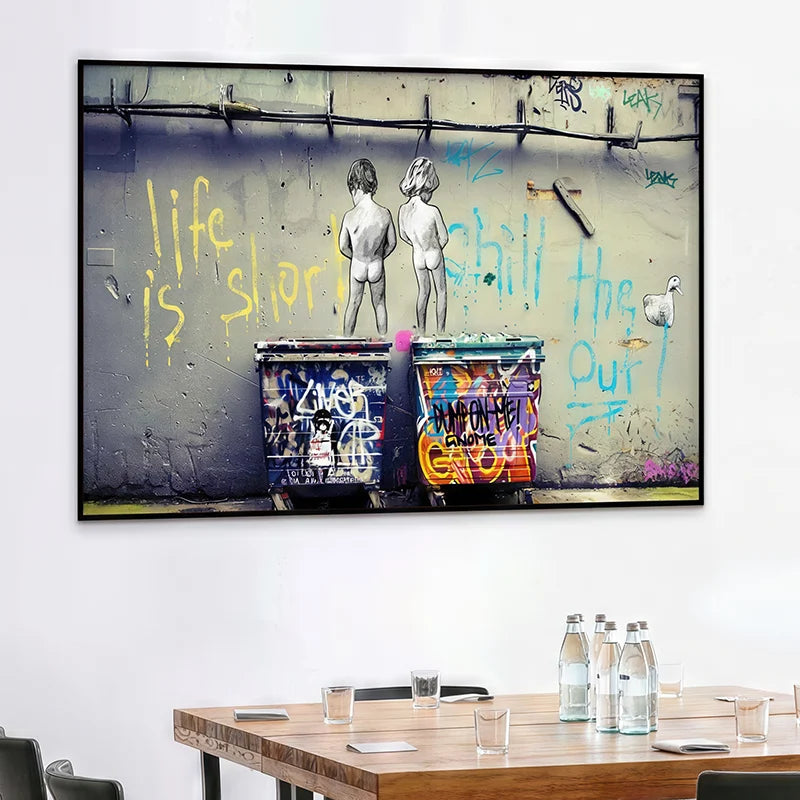
I immerse myself in the mystery surrounding Banksy, the unknown artist who brought urban art to a wider audience. His ability to create provocative works charged with political ideas on the dull façades of cities around the world has transformed the way we view graffiti. He succeeded in turning street art from a marginal pastime into a widely appreciated cultural phenomenon.
The marriage between graffiti and Pop Culture
The essential alliance between graffiti and pop culture marks a key stage in this popularization. Street art has gently woven itself into our daily lives, appearing in advertisements, music album covers, and even interior design. Just imagine your walls decorated with a piece inspired by this movement!
From concrete to art galleries
The transformation in how Street Art is perceived is remarkable. Once seen as an act of vandalism, it is now celebrated in some of the world’s most prestigious art galleries.Street artists are now regarded as contemporary virtuosos whose works are eagerly sought after by collectors and art lovers.
4/ The introduction of graffiti into interior design
The introduction of graffiti into interior design has given rise to a bold and vibrant trend. No longer limited to urban streets, graffiti is making its way into your home, bringing a touch of originality and a hint of artistic insolence. Far from any notion of vandalism, it is now a popular art form capable of breaking the monotony of a contemporary, refined space such as your living room.
- Imagine a wall enhanced by a colorful mural, the true focal point of your room.
- Picture the striking contrasts between the surrounding minimalism and the raw vitality of graffiti.
- Think of it as a reflection of your personality or beliefs.
- Notice how it energizes the space with its vibrant shades and provocative dynamic.
5/ Our artistic selection for urban decor
Taking into account the Artsy (2019) study, I want to highlight the importance of street art in contemporary decor. Its meteoric rise has transformed established codes, and its versatility has offered artists a new aesthetic palette.
For inspired urban decor, I’ve chosen standout works. The bold and ironic creations of Banksy have changed the way we see urban walls. The colorful work of Alice Pasquini brings a feminine touch to the street art landscape.
The hypnotic work of Tristan Eaton is also a must-see, with dynamic pop-art collages that bring any space to life. These artists have managed to breathe soul into their creations while redrawing the traditional lines of interior design.
Choosing street art as a decorative element reflects artistic sensitivity combined with active social and cultural engagement. Let yourself be charmed by this modern art form, whose beauty lies as much in its message as in its aesthetics.
To go further in your discovery of street art and find even more inspiration, feel free to explore our selection of Street Art Wall Art on this page.