
Street Art: Origins, Artists, and Urban Art Techniques
Are you drawn to street art and eager to understand where this interior design trend originated? Graffiti, stencils, collage, and sticker art: urban art developed in public spaces before entering our homes. It brings creative energy, bold colors, and genuine personality to wall décor.
In this guide, explore the origins of street art, its evolution from New York to France, the artists who shaped its history, and the main graffiti techniques. You will also learn how to choose street art wall art to create a focal point in a living room, bedroom, or office.
1. When and Where Did Street Art First Appear?
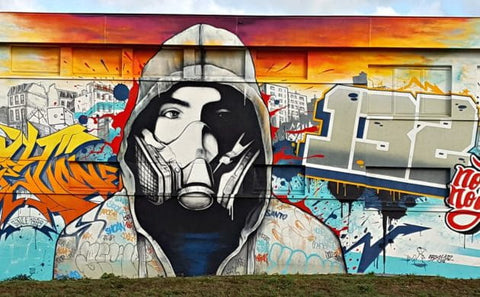
Urban inscriptions have existed for centuries, but modern forms of graffiti and street art primarily took shape in the United States in the late 1960s and throughout the 1970s. New York then became an open-air artistic laboratory: walls, tunnels, and subway cars provided canvases for a generation determined to be seen and heard.
From Tags to Monumental Murals
The tag is one of the earliest forms of contemporary graffiti. It is a stylized signature, often quickly created with spray paint. Artists then seek to develop their lettering, experiment with colors, and cover increasingly large surfaces. Throw-ups, pieces, and murals become steps toward a more complex visual language.
This culture has been subversive from the outset. In neighborhoods marked by inequality, graffiti allows residents and artists to assert their presence in the city. It engages with hip-hop music, dance, and fashion, while subverting the codes of advertising and mass culture.
2. The Development of Street Art in France
In France, urban art drew inspiration from exchanges with the New York scene while developing its own distinctive codes. Paris became an experimental playground for stencils, posters, collages, and graphic interventions in public spaces.
Blek le Rat and the rise of stencil art
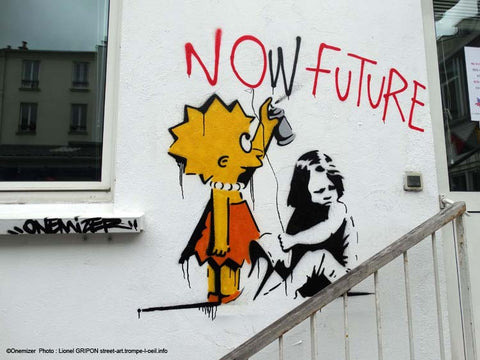
French visual artist Blek le Rat, the pseudonym of Xavier Prou, is often described as one of the pioneers of urban stencil art in France. His silhouettes and rats, stenciled on the streets of Paris in the early 1980s, helped popularize a more figurative and instantly recognizable approach to street art.
Stenciling makes it possible to prepare a shape with precision and then reproduce it quickly on a wall. This method became one of the visual hallmarks of the French scene.
His work went on to influence many international artists. Banksy has notably acknowledged the importance of this approach in his own visual language. To explore the subject further, read our article on the rise of street art as a popular art form.
3. How is street art defined?
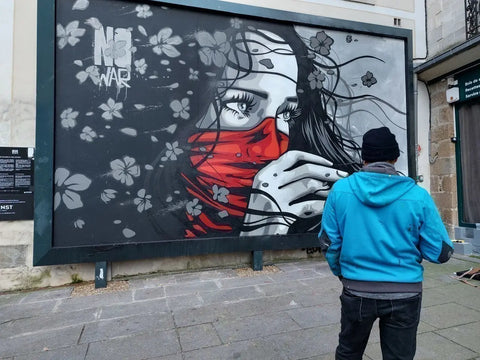
Street art refers to a range of artistic practices designed to be seen in public spaces. It can take the form of graffiti, a stencil, a collage, a sticker, or even a temporary installation. Far from being limited to vandalism, urban art now encompasses a wide variety of approaches, from unauthorized interventions to commissioned works created with permission from a city or property owner.
Many artists use their work to address society, politics, environmental issues, or popular culture. Others focus on color, humor, and graphic experimentation. What they share is a direct dialogue with the public and with the place where the work appears.
Some artists work under a pseudonym or choose to remain anonymous. Banksy is the best-known example, while Shepard Fairey, Invader, and many local artists have helped bring urban aesthetics into galleries, museums, and interior design.
4. The main urban art techniques
Graffiti vocabulary describes the size of the work, how quickly it is created, and how the letters or images are constructed. Here are the most common terms.
| Technique | Definition | Visual Effect |
|---|---|---|
| Tag | A stylized signature, often executed quickly. | Distinctive and recognizable lettering. |
| Throw-up | An enlarged version of a tag, created with just a few colors. | Rounded, legible, and highly visible shapes. |
| Stencil | A cut-out design painted through a template. | Clean outlines, silhouettes, and impactful messages. |
| Piece | A more ambitious composition, rich in detail and color. | Elaborate lettering, volume, and depth effects. |
| Blockbuster | Large block lettering, often painted with a roller. | Quick coverage of a large surface. |
| Top-to-bottom | A painting covering the full height of a train car. | Spectacular panoramic composition. |
| Wildstyle | Complex lettering with intersecting and interlocking letters. | Energetic graphics that can sometimes be difficult to decipher. |
| Sticker Art and Yarn Bombing | Stickers or textile pieces installed in the street. | Quick, unconventional, and easily recognizable interventions. |
5. How to Incorporate Street Art into Your Interior Décor
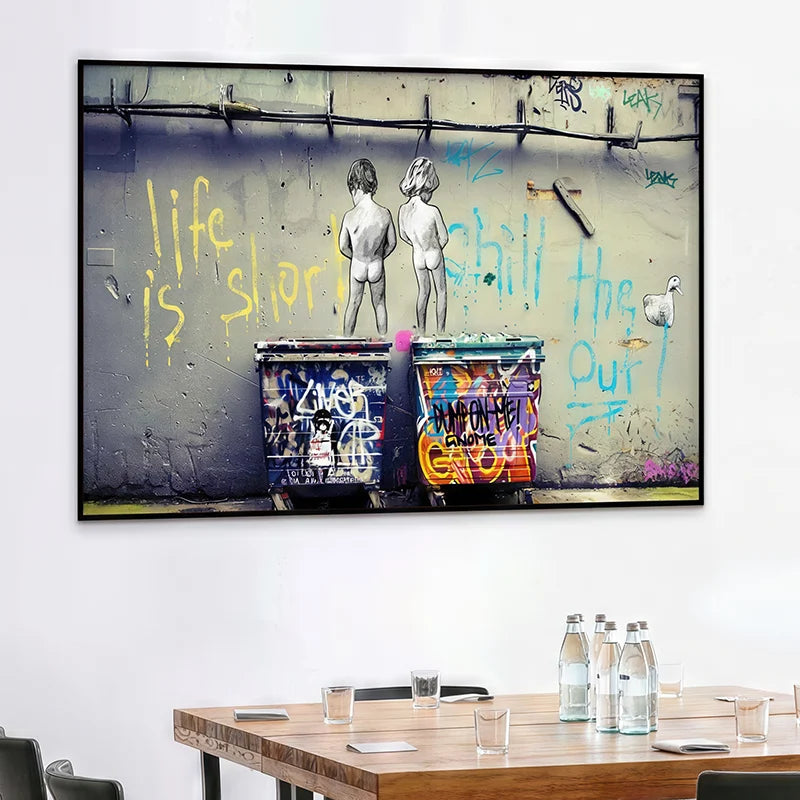
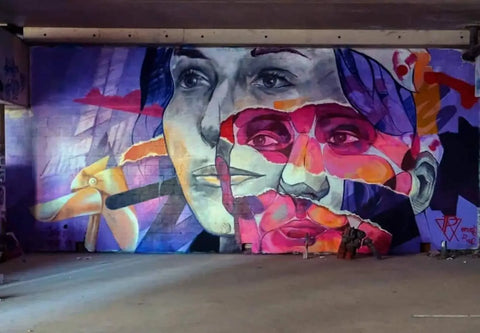
There is no need to turn your entire home into an urban art gallery. A single graffiti wall art piece can become the focal point of a living room, entryway, or office. The key is to choose an artwork whose size, colors, and message complement your furniture.
Choosing the Right Size and Placement
- Large wall: choose a bold statement piece or a diptych to balance the space.
- Living room: hang the wall art above the sofa and echo one of its colors in the cushions or rug.
- Bedroom: choose a less contrasting design or a softer palette to maintain a relaxing atmosphere.
- Office: graphic lettering or a pop culture image can spark creativity.
Pairing the Artwork with Materials and Finishes
A street art canvas stretched over a frame adds warmth and character. An unframed poster offers a lighter option, while a black floating frame highlights the contrasts and enhances the gallery feel. An acrylic glass print is ideal for contemporary décor thanks to its glossy finish.
To maintain visual harmony, pair the artwork with clean lines, wood, black metal, or solid-colored textiles. Avoid mixing too many competing patterns: the wall art should remain the centerpiece of your wall décor.