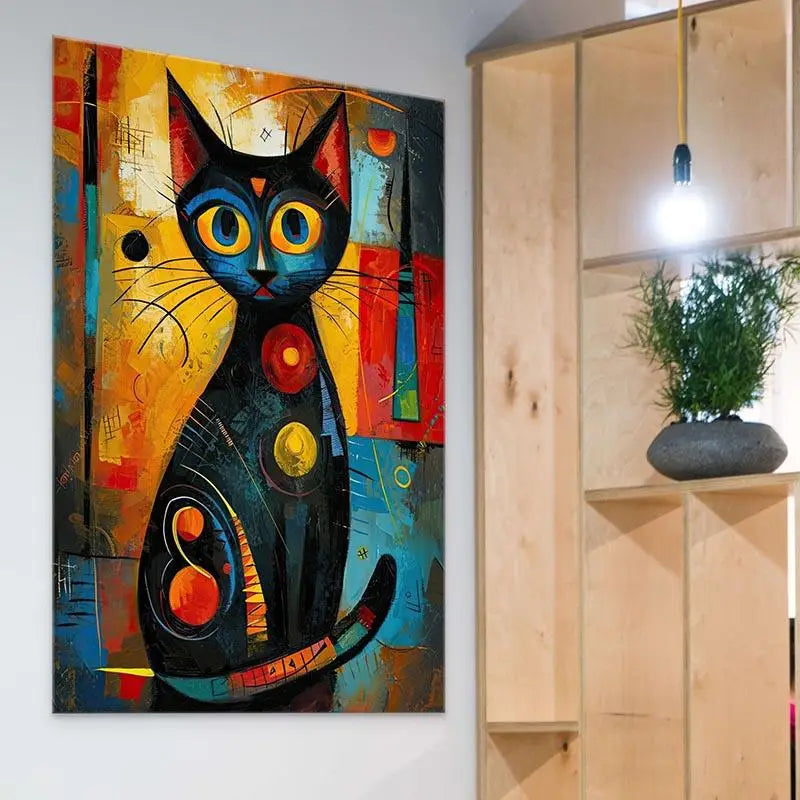

How to repair a tear in wall art? Tips and techniques
Poor handling, an impact during a move, improper storage or simply a household accident: a canvas can unfortunately tear.
Should you try to repair it yourself? Can a torn canvas be glued back together? At what point should you entrust the wall art to a professional conservator? Here are the key points to know before taking action.
Yes, some canvas tears can be restored, but the method depends on the support, the extent of the damage and, above all, the value of the artwork.
For an original, old, signed, or valuable artwork, avoid any improvised repair: the wrong glue, stitching, or paint touch-up can make professional restoration much more difficult.
Is it possible to repair all tears in wall art?
Restoration depends above all on the nature of the support and the overall condition of the wall art. A small clean cut in a recent canvas obviously does not present the same difficulties as significant material loss on an old painting.
Before any intervention, observe several factors: size of the tear, location, condition of the fibers, presence of flaking paint, canvas distortion and the value of the artwork.
What types of wall art can be repaired?
Canvas on stretcher frame
This is one of the most common cases. Depending on the damage, the conservator can work directly on the back of the canvas or may need to partially remove it from the stretcher frame.
Painting on canvas
The difficulty mainly comes from the paint layer. The fibers must be brought together without creating distortion and without causing any further paint flaking.
Canvas mounted on cardboard
The presence of a rigid support makes the treatment different. The conservator must examine both the canvas and the cardboard in order to identify the best consolidation method.
Wood or fiberboard
It is no longer really referred to as a tear but rather a crack, break, or loss of material. These supports require specific methods which differ significantly from the restoration of a textile canvas.
What are the main types of tears?
Not all tears look the same. The shape of the damage directly affects the difficulty of the restoration.
| Type of damage | Appearance | Level of difficulty |
|---|---|---|
| Straight slit | Relatively clean cut with no significant canvas loss. | Often the easiest to treat. |
| Irregular tear | Deformed, frayed, or displaced fibers. | More delicate. |
| Tear with a hole | Part of the support has disappeared. | Specialized restoration recommended. |
| Significant deformation | The canvas is slack, dented, or severely stretched out. | Professional intervention recommended. |
A tear located in a dark or uniform area is generally easier to retouch visually than a cut running across a face, a very precise detail or a signature.
Who can repair damaged wall art?
Calling on a professional restorer
A painting restorer has the knowledge and tools needed to reinforce the support while preserving the artwork.
They can, in particular, examine the tension of the canvas, the condition of the paint layer, the fibers around the tear and determine whether the canvas needs to be removed from the stretcher frame.
- the wall art is old or original;
- the artwork has significant financial or sentimental value;
- the paint is lifting around the tear;
- part of the canvas is missing;
- the support is severely deformed;
- the tear runs across a face, a signature, or an essential detail.
Can you repair a canvas yourself?
For a recent decorative canvas of low value, a small, clean cut can sometimes be stabilized. But a DIY repair always remains a compromise.
In particular, avoid pulling the fibers abruptly, sewing the canvas like a piece of clothing or randomly applying a very strong glue to the front of the artwork.
What techniques are used to restore a torn canvas?
Restorers have several methods available. The choice depends on the nature of the tear, the canvas weave and the condition of the paint.
1. Edge-to-edge repair
This technique involves bringing together precisely the two edges of a tear without overlapping them.
The goal is to restore the continuity of the support as much as possible.
2. Thread-by-thread
For certain tears, the fibers can be repositioned or completed individually.
This intervention requires great precision to avoid creating excess thickness.
3. Inlaying
When part of the support is missing, a compatible canvas fragment can be prepared to fill the loss.
This technique is mainly intended for experienced restorers.
What materials are used to repair a canvas?
The materials vary depending on the chosen method. As part of a restoration, these include:
- a fabric or canvas compatible with the original support;
- fine brushes and flat brushes;
- precision tools for repositioning the fibers;
- a perfectly clean work surface;
- adhesives suitable for conservation;
- filling materials for losses;
- retouching products compatible with the paint layer.
The choice of adhesive is particularly important. An unsuitable glue can harden, yellow, penetrate the paint or become difficult to remove several years later.
What should you do when a decorative canvas has a small tear?
If the wall art is a recent decorative piece with no heritage value and the tear remains very limited, the first priority is to not making the damage worse.
Do not handle the damaged area any further
Avoid pulling on the fibers, rubbing the front or trying to force the canvas back into place.
Remove the wall art from the wall
Place it in a clean, dry, stable place to prevent a second impact from enlarging the tear.
Observe the condition of the paint
If the paint lifts, flakes or falls away around the cut, stop handling it.
Decide whether professional intervention is justified
A small decorative canvas can sometimes be repaired simply. For an important work, instead, ask a restorer for advice.
How can the repair be made less visible?
Once the support has been stabilized, a slight scar may remain. Aesthetic restoration then consists of to visually reduce this mark without unnecessarily covering the original paint.
On certain works, a restorer can use a filling material, then carry out a localized color retouch.
The goal is normally not to repaint a large part of the wall art, but to blend the restored area in so that it no longer immediately draws the eye.
What about wall art on wood or cardboard?
Rigid supports are not restored like a stretched canvas on a frame. A crack in a panel, a broken board or a detached paint layer require a specific analysis.
In some cases, consolidation or lining may be considered. These processes are designed to reinforce the support by adding an additional structure to the back of the work.
Marouflage is another technique used in certain conservation work: a flexible surface is fixed to a more rigid support to give it greater stability.
How can you prevent a canvas from tearing?
The best restoration is still the one that can be avoided. A few simple habits can to significantly reduce the risks.
Handle the wall art by the stretcher frame
Avoid placing your fingers or hand in the center of the canvas when moving it.
Protect the corners
During a move, the corners and sides should be sufficiently protected to prevent knocks against other objects.
Avoid humidity
High humidity can weaken certain materials and encourage them to warp.
Store the wall art vertically
Avoid stacking heavy objects directly on a canvas, even for a short period.
What if you simply felt like refreshing your decor?
Repairing a wall art piece you care about is often the best solution. But when a decorative canvas is too badly damaged, it can also be an opportunity to create a new atmosphere in the room.
Discover a few Montableaudeco worlds to find a piece suited to your interior:
An empty wall can become the focal point of your interior
Abstract, contemporary, Street Art, reproduction of a famous work or original creation: find the wall art that matches your personality and your décor.
Discover our decorative wall artFAQ: repairing a torn wall art piece or canvas
Can a torn canvas be repaired?
Yes. A torn canvas can often be restored. The difficulty depends on the size of the cut, of any potential loss of material, of the condition of the paint and the value of the artwork.
Can a canvas be glued back from the rear?
Some restoration techniques are indeed applied on the back of the canvas. The choice of adhesive and reinforcement material is, however, essential, especially for an antique or original piece.
Should you sew a torn canvas?
Classic stitching done as on a garment can create tension and distortion. Restorers favor more precise methods to bring together or reposition the canvas fibers.
When should you call in a restorer?
For an original, antique, signed or valuable, for a significant tear or when the paint is flaking, it is preferable to consult a professional restorer.
Can a canvas repair become invisible?
Quality restoration can make a very discreet tear. However, the result depends of the location of the damage, of the paint and the condition of the fibers.
How do you protect a canvas during a move?
Handle it by its stretcher frame, protect the corners, avoid any object in direct contact with the surface and never place any weight on the canvas.
What should I do if my decorative wall art is beyond repair?
If the repair cost exceeds the value of a recent decorative canvas, you can consider replacing it and take the opportunity to evolve your wall décor.
In short: how do you repair a tear in a wall art piece?
A small tear does not necessarily mean that a wall art piece is beyond saving. Many canvases can be reinforced and restored with a very satisfying result.
The most important rule remains simple: the more valuable the artwork is, the more careful the intervention must be. For an original or antique painting, it is best to call in a restorer rather than risk making the damage worse.
And if you simply want to refresh the atmosphere of your interior, explore our collections and find a new piece that will bring character to your walls.
Discover the latest arrivals