
Urban Art News & Décor
In 2026, Banksy remains one of the most fascinating figures in street art. His stencils, installations and thought-provoking messages continue to challenge our society, while his anonymity keeps the mystery alive. Explore his recent work, his influence on contemporary art and how to incorporate Banksy wall art into your décor.

Banksy is often described as the “ghost of urban art.” Behind this pseudonym is an artist whose identity has never been officially revealed, yet whose images are recognized worldwide. With just a few strokes, a stencil can raise a smile, create unease or spark a debate about politics, war, inequality, the environment and freedom of expression.
This ability to combine an instantly understandable image with deeper reflection explains Banksy's unique place in contemporary art. His work often begins in the street, but is later discussed in the media, exhibited, collected and adapted for wall décor. This transition between public space, popular culture and private interiors is what makes his journey so compelling.
Why Is Banksy Still So Fascinating in 2026?
Banksy has built a recognizable artistic identity without revealing his personal identity. His images generally combine simple compositions, bold contrasts and ideas that can be understood in seconds. Yet beneath this apparent simplicity, they remain open to multiple interpretations.
In 2026, his influence extends far beyond graffiti. His visual language can be found in contemporary art, photography, communication, fashion, immersive exhibitions, and interior design. This popularity stems from the power of his messages, but also from the speed at which his works circulate through the media and social networks.
Paradox lies at the heart of his success: Banksy often criticizes the commercialization of art, yet he has become a highly sought-after artist among collectors. He champions the visibility of art in public spaces, but his works are also protected, relocated, restored, or sold for high prices. These contradictions do not diminish his impact; on the contrary, they fuel discussions surrounding his work.
Banksy's recent works: key developments in 2025 and 2026
Discussing “Banksy's latest works” requires caution, as the artist's interventions can appear without prior notice and their attribution must be confirmed. Several recent developments nevertheless provide insight into the direction his work has taken.
A sculpture confirmed in London in April 2026
On April 30, 2026, Banksy confirmed that a sculpture installed overnight at Waterloo Place in London was his work. It depicts a man walking with a flag concealing his face. This intervention is particularly interesting because it shows that the artist does not limit himself to painted walls: he can also use three-dimensional forms, staging, and the subversion of national symbols to convey his message.
This creation also reminds us that surprise is part of Banksy's method. The artwork appeared in a public space before being authenticated through a post by the artist, creating a period of uncertainty that immediately attracted attention.
Ephemeral artworks that are sometimes removed
In September 2025, a mural that appeared near the Royal Courts of Justice in London depicted a judge striking a protester. The artwork was later removed because of the building's protected status. This episode illustrates the fragility of street art: even when an image becomes famous, it can disappear for legal, administrative, or preservation-related reasons.
In Venice, restoration work also began in 2025 to preserve the Migrant Child mural, painted on a building exposed to moisture. Here, the issue is not the removal of the artwork, but its preservation in the face of time and weather conditions.
Banksy, an icon of contemporary art
Banksy has helped change the perception of street art. Once regarded by some of the public as mere urban vandalism, street art is now studied, exhibited and discussed as an art movement in its own right. Banksy is not solely responsible for this shift, but his fame has played a major role in drawing attention to creative work in public spaces.
His work challenges the traditional boundaries of art. A work can appear on a wall without permission, be photographed by passersby, go viral online, and then be discussed in a gallery or auction room. The location where it appears is part of its meaning: a stencil placed near a political symbol is not interpreted in the same way as an image displayed in an interior.
An instantly recognizable visual language
Black and white, silhouettes, animals, children, police officers, repurposed objects and splashes of color have become hallmarks of Banksy's world. This visual clarity also explains the power of his images in interior décor: a composition can draw the eye without requiring much space or a lengthy explanation.
Art that leaves room for interpretation
A Banksy image does not always provide an answer. It often juxtaposes two seemingly opposing elements: authority and vulnerability, childhood and violence, consumerism and poverty, humor and gravity. Viewers are invited to complete the message through their own experience.
The cultural impact of Banksy's street art
Banksy's influence can be measured both by the recognition of his works and by the conversations they spark. An image can be shared by millions of people, inspire a new generation of artists or change the way a neighborhood is perceived.
His work has also helped bring contemporary art closer to the general public. It is not aimed solely at museum visitors or discerning collectors: a street intervention can be seen for free by a passerby, a local resident, a child or a tourist. This accessibility makes his message more direct, even when its interpretation remains open.
- In popular culture: his images are recognized far beyond the art world.
- In public debate: his works address war, migration, surveillance, inequality and the environment.
- In urban art: his career inspires artists to use walls and cities as spaces for expression.
- In interior design: his visual style can create a contemporary, thought-provoking, and highly personal atmosphere.
The mystery of Banksy’s identity
Banksy’s identity remains officially unknown. For years, investigations and theories have attempted to identify the artist behind the pseudonym, but no revelation should be presented as confirmation from Banksy. This distinction is important: a theory reported in the press is not necessarily an established fact.
Anonymity plays several roles in his work. It protects his privacy, fuels public curiosity, and forces people to focus on the images rather than on an individual’s fame. It also reinforces the contrast between the global visibility of his creations and the discretion of the person who signs them.
Anonymity as an integral part of the message
In a world where artists are often presented as personal brands, Banksy maintains a rare distance. His artist name becomes a storytelling device, almost a character. This absence of a face leaves more room for the image, the context, and the public’s reaction.
However, the mystery should not overshadow the content of the works. Banksy’s presumed identity is less important than the themes he depicts and the questions he raises about society.
Banksy and the art market: between criticism and desire
Works attributed to Banksy hold a highly prominent place in the art market. Their value can depend on many factors: provenance, authenticity, medium, condition, rarity, subject matter, and ownership history. It is therefore impossible to determine the value of a piece based solely on a popular image.
This situation creates a paradox. Banksy regularly criticizes the commercialization of art and the mechanisms of speculation, yet his works are sought after by collectors and sold through auction houses. This tension between an anti-consumerist message and financial value has become a recurring topic in discussions of his work.
Original, edition, and decorative wall art: know the difference
Before buying Banksy wall art, always check the exact nature of the product. An original artwork, a limited edition, an art print, and a decorative piece inspired by urban art are not the same purchase. A print intended to decorate a living room must not be presented as an original signed by Banksy.
For a collectible acquisition, look for provenance information, authenticity documents and the guarantees offered by the seller. For affordable wall decor, focus instead on visual quality, size, medium and how well it complements your interior. In both cases, transparency on the product page remains essential.

Public art accessible to all
For Banksy, choosing a public space is not merely about the setting. The street makes it possible to reach people who may not visit galleries and to bring the artwork face to face with everyday life. Passersby encounter the image without a label, without a ticket and sometimes without immediately knowing who created it.
This accessibility explains why photographs play such an important role in the life of street art. An artwork may physically disappear yet continue to circulate as an image. It can then be discussed, adapted, reproduced or reinterpreted by other artists.
However, there is a difference between making art visible and reproducing an artwork for commercial purposes. An image's fame does not eliminate questions of rights, provenance and presentation. Readers looking to decorate their homes should choose a clearly described product and avoid confusing a visual tribute, decorative print and original artwork.
How to incorporate Banksy wall art into your decor
Banksy-inspired wall art can become a true signature piece in an interior. Its graphic style pairs beautifully with modern, industrial, minimalist or eclectic decor. The key is to give it enough space to be appreciated: a striking artwork does not need to be surrounded by numerous accessories.
Create contrast on a light-colored wall
On a white or beige wall, a black-and-white image creates a crisp, elegant contrast. A touch of red, yellow or blue can then be echoed in a cushion, vase, rug or light fixture. This technique creates visual continuity without turning the room into a themed space.
Pair the artwork with simple materials
Wood, black metal, concrete, leather and natural textiles complement the urban aesthetic beautifully. Furniture with clean lines allows the wall art to remain the focal point. If your interior is already very colorful, opt for a monochrome composition or artwork featuring shades that echo the existing palette.
Choose the right medium
The medium changes the impact of the wall art in the room. An unframed poster creates a light, accessible look. A stretched canvas adds a warm finish. A black floating frame highlights the contrasts and enhances the contemporary feel, while a white floating frame blends more subtly into a bright interior. Finally, an acrylic glass print offers a glossy, modern finish.
The size should be chosen according to the wall and the sofa, sideboard, or bed below it. Wall art that is too small may get lost, while an oversized piece can make the space feel unbalanced. Before ordering, visualize the dimensions using masking tape or a paper template.
Looking for wall decor inspired by urban art?
Explore the Montableaudeco Banksy wall art collection and choose the style, size, and medium that best suit your interior.
Banksy wall art in a bedroom: a personal urban touch
In a bedroom, Banksy wall art can add character without taking over the entire space. It is especially well suited to a teenager's or young adult's bedroom, or to a room inspired by music, fashion, graffiti, or urban culture.
Above the bed
A horizontal format or an arrangement of several images works well above a wide bed. In a narrower bedroom, vertical wall art can be placed on a side wall. Avoid using too many messages and patterns: one main piece is often enough to give the room its own identity.
Which colors work best?
Black and white works well in a minimalist bedroom. For a more vibrant feel, choose a piece with an accent color and echo it in the bedding or a few accessories. Beige, gray, navy blue, and terracotta tones help maintain a balanced atmosphere despite the thought-provoking nature of urban art.
Banksy wall art in a living room: tips and inspiration
The living room is where Banksy wall art will be seen most often. The wall behind the sofa is a natural location, but a sideboard, bookcase, or home office corner can also serve as a focal point.
Above the sofa
The wall art should remain proportional to the width of the sofa. A horizontal piece, a diptych, or an arrangement of several sizes can easily fill a long wall. Leave some space around the artwork and make sure the center of the image remains comfortable to view from the main seating areas in the living room.
In an industrial interior
Pair the wall art with a metal coffee table, raw wood, black lighting, and understated textiles. A few plants can soften the overall look. The aim is to create a dialogue between the energy of the image and the warmth of the furniture, without recreating the raw appearance of a street wall throughout the room.
In a classic or contemporary interior
The contrast can be particularly striking with a sleek sofa, decorative moldings or refined materials. In this case, choose a single statement piece with a carefully selected frame. Black-and-white wall art can create a subtle transition, while a colorful image will make a bolder statement.

Choose large-format Banksy wall art for maximum visual impact
Large-format Banksy wall art is ideal for spacious walls and rooms that lack visual depth. It immediately draws the eye and can anchor the entire decor. This option often creates a clearer visual statement than a collection of smaller images.
Before choosing a large format, measure the wall's width and height, as well as the available space around the furniture. Consider doors, windows, electrical outlets and walkways. A full-size template will help you check that the artwork looks neither too small nor overpowering.
On a very wide wall, you can also create an arrangement with two or three coordinated wall art pieces. To maintain visual harmony, keep one element consistent: the same palette, medium, frame style or a similar visual theme. A cohesive series can evoke an urban gallery while still feeling at home in your interior.

Stenciling, graffiti and urban art techniques
Stenciling is the technique most often associated with Banksy, but street art is not limited to this method. Urban art encompasses a wide range of practices that can be translated into decorative wall art.
- Stenciling: cut-out shapes make it easy to quickly reproduce a silhouette or pattern with crisp outlines.
- Graffiti: lettering, drips and bright colors add a more spontaneous, expressive energy.
- Collage: photographs, posters, typography and paper are layered to create a richly textured image.
- Creative reinterpretation: an object, character or symbol takes on a new meaning when placed in an unexpected context.
- Graphic composition: blocks of color, contrasts, geometric shapes and short messages make the artwork easy to read from a distance.
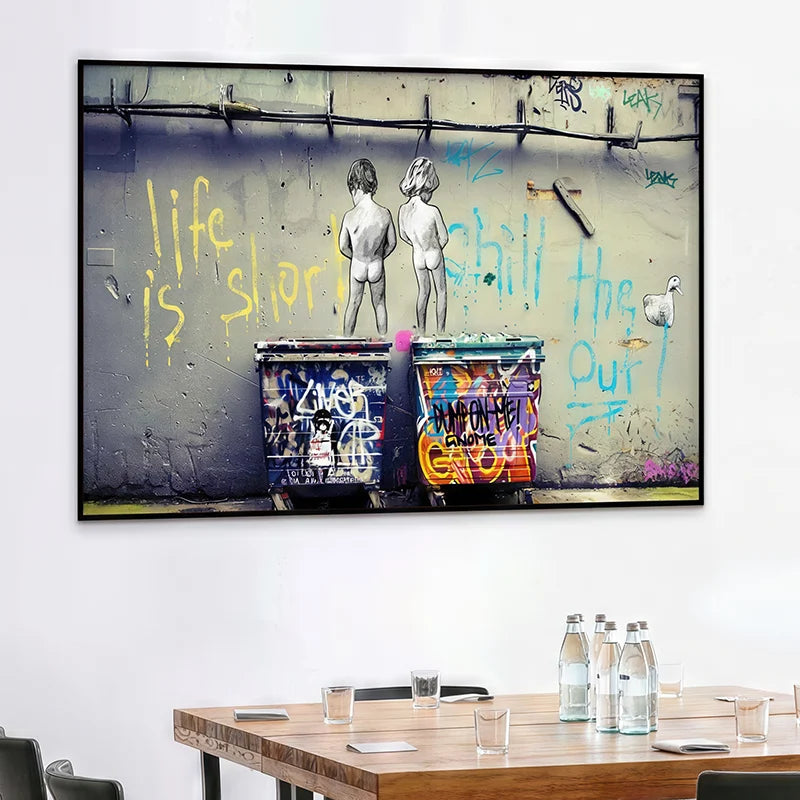
When choosing wall art, first consider the mood you want to create. A black-and-white stencil will bring a refined, graphic feel. Colourful graffiti will energise a neutral wall. An image with a touch of humour will add a lighter note, while a social or political subject will give the room a more thought-provoking dimension.

Displaying and caring for Banksy wall art at home
The chosen location can enhance or diminish the impact of an artwork. Hang the wall art at a comfortable viewing height and consider where you most often view it from when using the room. Above a sofa or sideboard, leave some visual space between the furniture and the artwork.
Lighting is equally important. Avoid direct sunlight and prolonged exposure to heat sources whenever possible. Indirect natural light or adjustable lighting highlights the contrasts while minimising reflections on glossy surfaces.
For care, dust the surface with a soft, dry cloth. Do not apply abrasive products or liquids directly to the wall art. In a humid room, make sure the material and location are suitable. Secure mounting is essential for large formats and heavier materials.
Banksy, urban culture and contemporary design
Banksy's aesthetic blends effortlessly into contemporary design because it relies on clear contrasts and instantly recognisable imagery. It can add rhythm to a white room, enhance the character of a loft or create a striking contrast in a more traditional interior.
To maintain an elegant interior, avoid an all-over street art look. A single statement wall art piece, paired with natural materials and understated furniture, will often have more impact than a wall covered in patterns. The contrast between urban art and a warm setting creates a more balanced atmosphere.
You can also build your colour palette around the artwork: black and white for a graphic feel, midnight blue and beige for a softer look, or red and yellow for a more vibrant room. The colours in the wall art then become a unifying thread connecting the walls, textiles and accessories.
FAQ: Your questions about Banksy and his wall art
Why is Banksy famous?
Banksy is famous for his street art, particularly his satirical and thought-provoking stencils. His images explore social, political and humanitarian issues through a blend of humour, contrast and provocation.
Is Banksy Still Anonymous in 2026?
Yes. Many theories circulate about his identity, but no revelation should be regarded as official confirmation from the artist. His anonymity remains an important part of his public image and artistic approach.
What Are Banksy's Latest Works in 2026?
Among the recent developments reported, Banksy confirmed in April 2026 that a sculpture installed in London depicting a man whose face is obscured by a flag was his work. Other pieces that appeared in 2025 were removed or restored, highlighting the evolving and sometimes ephemeral nature of his work.
Which Banksy Wall Art Should You Choose for a Living Room?
Choose artwork that is proportionate to the width of the sofa or furniture beneath it. Large wall art can become the room's focal point, while a composition of several sizes works well on a longer wall. Coordinate one or two colors with the cushions, rug or curtains.
Is Banksy Wall Art Sold Online Always an Original?
No. It may be a decorative print, reproduction, edition or original artwork. Always check the product details, medium, provenance and any authenticity documents provided. Banksy-inspired decor should not be mistaken for a certified original.
How Do You Care for Street Art Wall Art?
Dust it with a soft, dry cloth, avoid abrasive products and protect it from direct sunlight, heat and excessive humidity. For large-format wall art, regularly check that the mounting and support are secure and stable.
Conclusion: Banksy in 2026, an Influence as Strong as Ever
Banksy continues to fascinate because he combines striking visual simplicity with complex subjects. His anonymity, unexpected interventions and critical perspective on society sustain a conversation that extends far beyond graffiti.
In 2026, recent developments also show that street art can take many forms: stencils, murals, sculptures, installations or images shared online. This diversity explains why Banksy's creative world continues to influence contemporary culture and wall decor.
If you want to add an urban, expressive touch to your interior, discover the Montableaudeco Banksy Wall Art Collection. Choose your design, size and medium to suit the room, your style and the atmosphere you want to create.